
How to Measure Shopify Email Performance Beyond Open Rate
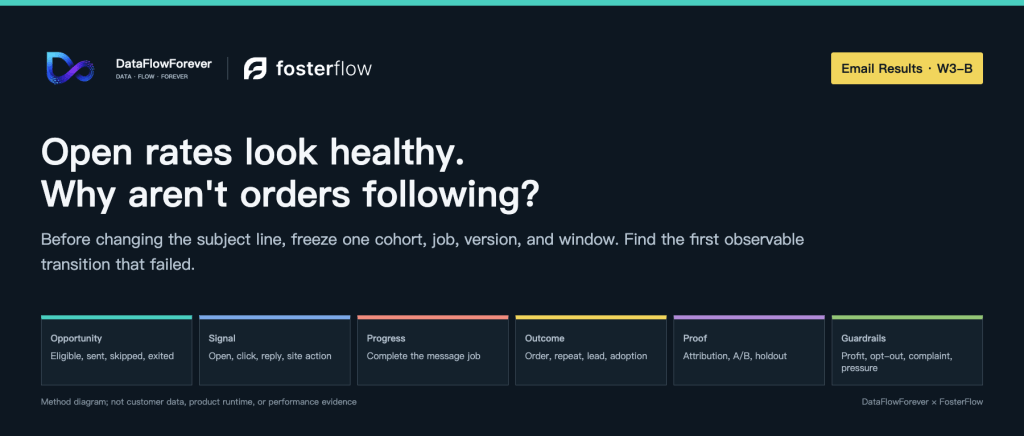
Your Shopify email dashboard can show a healthy open rate while orders stay flat. That does not prove the subject line worked and the body failed. It does not prove the list is healthy, the email reached the primary inbox, or the Flow created revenue.
To measure Shopify email performance beyond open rate, choose one comparable audience, message job, version, and window. Then follow the same eligible profiles through:
- send, skip, wait, and exit decisions;
- delivery and signal-quality checks;
- the customer action the message was meant to support;
- Shopify orders or another selected business outcome;
- attribution or experiment evidence;
- profit and relationship guardrails.
The first weak transition tells you where to investigate. It may be the audience, Flow execution, message, offer, product page, checkout, measurement policy, or economics. This guide provides a repeatable Shopify email performance audit without treating any one rate as the answer.
The eight-part Shopify email performance audit
Use this sequence for one Campaign or Flow before reviewing the whole account.
| Audit step | Question to answer |
|---|---|
| 1. Message job | What should this customer understand, complete, or resolve? |
| 2. Eligible population | Who qualified, and which exclusions or current states apply? |
| 3. Runtime | Who waited, sent, skipped, exited, or transitioned, and why? |
| 4. Signal quality | Which opens, clicks, replies, and site events are credible under the declared policy? |
| 5. Customer progress | Did the message move the shopper to the intended next step? |
| 6. Business outcome | Did orders, repeat purchase, product use, or net value change? |
| 7. Proof | Is the evidence attribution, self-comparison, A/B, or a no-marketing holdout? |
| 8. Guardrails | What happened to discounts, returns, unsubscribes, complaints, and pressure? |
Do not skip to step seven because the email platform reports attributed revenue. The evidence needed to explain what ran comes before the evidence used to estimate what changed.
1. Give every Campaign or Flow one measurement job
A Shopify store can send a Welcome message, cart reminder, delivery guide, product education email, replenishment reminder, and winback offer in the same month. Those messages should not share one primary KPI.
Examples:
- Welcome: deliver the signup promise, establish relevance, or support a first confident product decision.
- Cart or checkout recovery: preserve the correct path back and resolve a supported obstacle while stopping after purchase.
- Post-purchase: help the customer receive, set up, use, or evaluate the product before asking for another commercial action.
- Replenishment: reach a customer near an evidence-backed consumption or replacement window.
- Winback: provide a credible new reason to return after a meaningful lapse.
- Product update: create awareness, required action, education, adoption, or expansion for the affected audience.
Write the message job in one sentence, then select one primary outcome. Opens and clicks can remain diagnostics. The commercial result should match the job. A setup guide may be judged through successful use, support demand, return behavior, or a later repeat outcome rather than immediate second-order revenue.
This prevents a common reporting error: promoting the easiest available metric into the goal of every message.
2. Freeze the audience, version, and window
Before comparing this send with a previous one, check whether the populations are actually comparable.
Record:
- acquisition source and signup promise;
- marketing consent, reachability, and suppression;
- lifecycle and prior-purchase state;
- product, collection, cart, order, or support context;
- geography and other permitted fields that materially affect the decision;
- subject, body, offer, CTA, destination, and Flow-rule changes;
- send period, timezone, conversion window, and expected data delay;
- refund, cancellation, return, and late-conversion treatment.
An open rate can remain stable while the store shifts from returning buyers to new discount subscribers. A click rate can fall because the product mix changed. Attributed revenue can change after a window or model setting changes even when the underlying Shopify orders do not.
Self-comparison is useful only when these definitions are stable or the break is documented.
3. Reconcile Flow runtime before engagement
For a Flow, entry is not the same as permission to send every later message. A shopper can purchase while a recovery email is waiting. Consent, inventory, price, delivery, support state, or contact pressure can change. The current version can fail to run or skip a profile for a valid reason.
Track at least:
- profiles eligible for the customer job;
- profiles entering the Flow or Campaign audience;
- waiting or manual-review states;
- send decisions;
- skip reasons;
- exits and transitions;
- delivered messages.
Use the denominator that belongs to the question. Flow entrants can help diagnose entry. Eligible profiles can show opportunity. Delivered recipients can support delivery-based response rates. None should be substituted silently for another.
If a large share never received a valid treatment, fix the trigger, eligibility, suppression, event correlation, or per-send checks before judging the content.
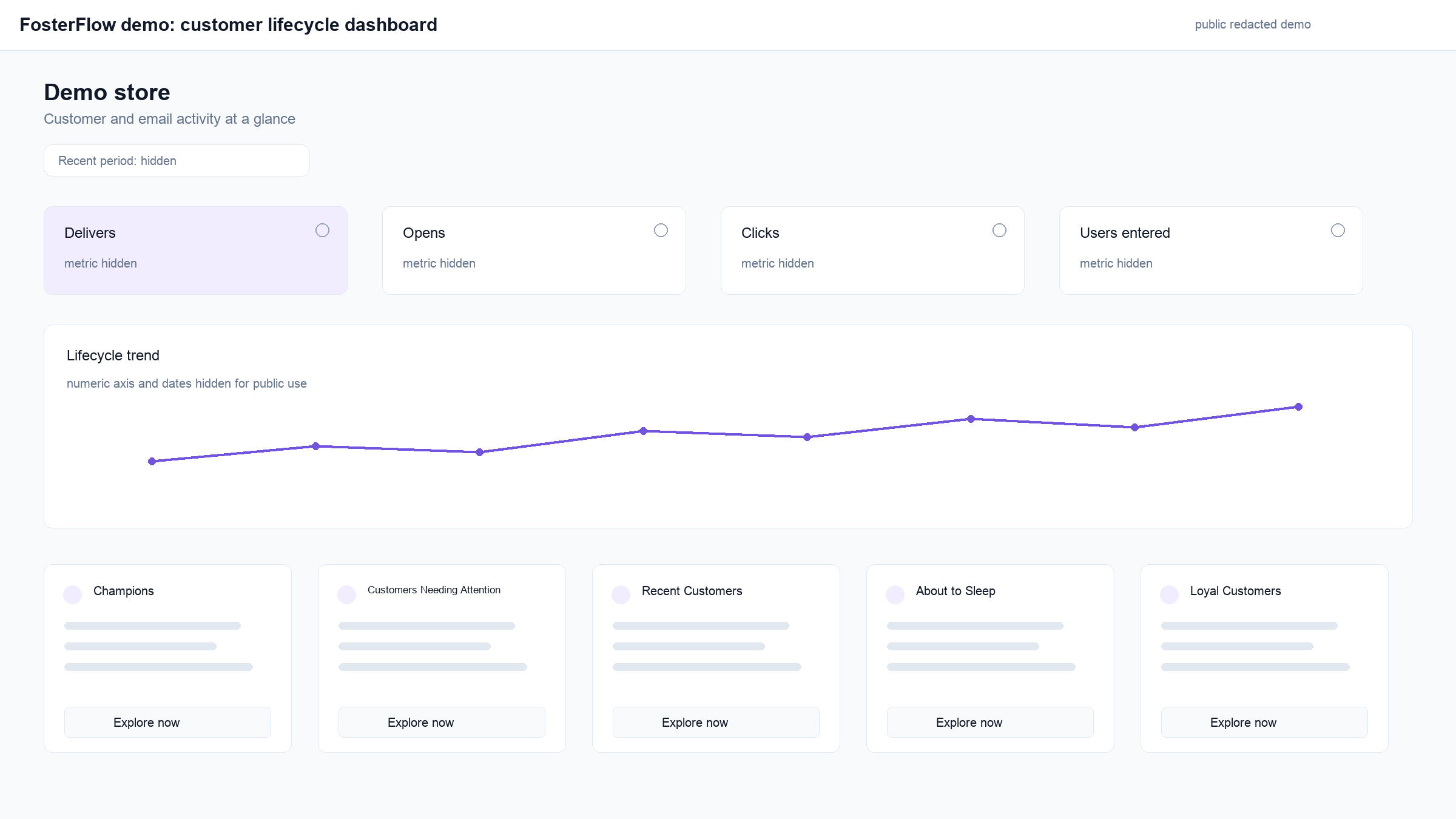
The screenshot above is a public-safe, point-in-time FosterFlow demonstration of a lifecycle reporting structure. It does not prove current runtime, live customer counts, metric accuracy, or merchant performance.
4. Interpret Shopify email opens with an explicit MPP policy
Apple Mail Privacy Protection can load remote content through proxy infrastructure before or without a person reading the message. Security and preview systems can affect click records. An observed tracking event is therefore not automatic evidence of human attention.
Where the provider makes the data available, retain:
- the raw event;
- MPP classification as true, false, or unknown;
- bot or security classification;
- unique and total event definitions;
- event and deduplication policy version;
- whether the report, segment, or test includes the classified event.
MPP does not make opens useless. With a stable population and policy, reported opens can help investigate subject treatment, audience change, or a measurement break. They should not independently qualify a high-intent segment or prove inbox placement, reading, list health, or future purchase.
For a consequential decision, continue to filtered clicks, replies, current site behavior, add-to-cart or checkout progress, Shopify orders, and customer state.
5. Keep the denominator beside every rate
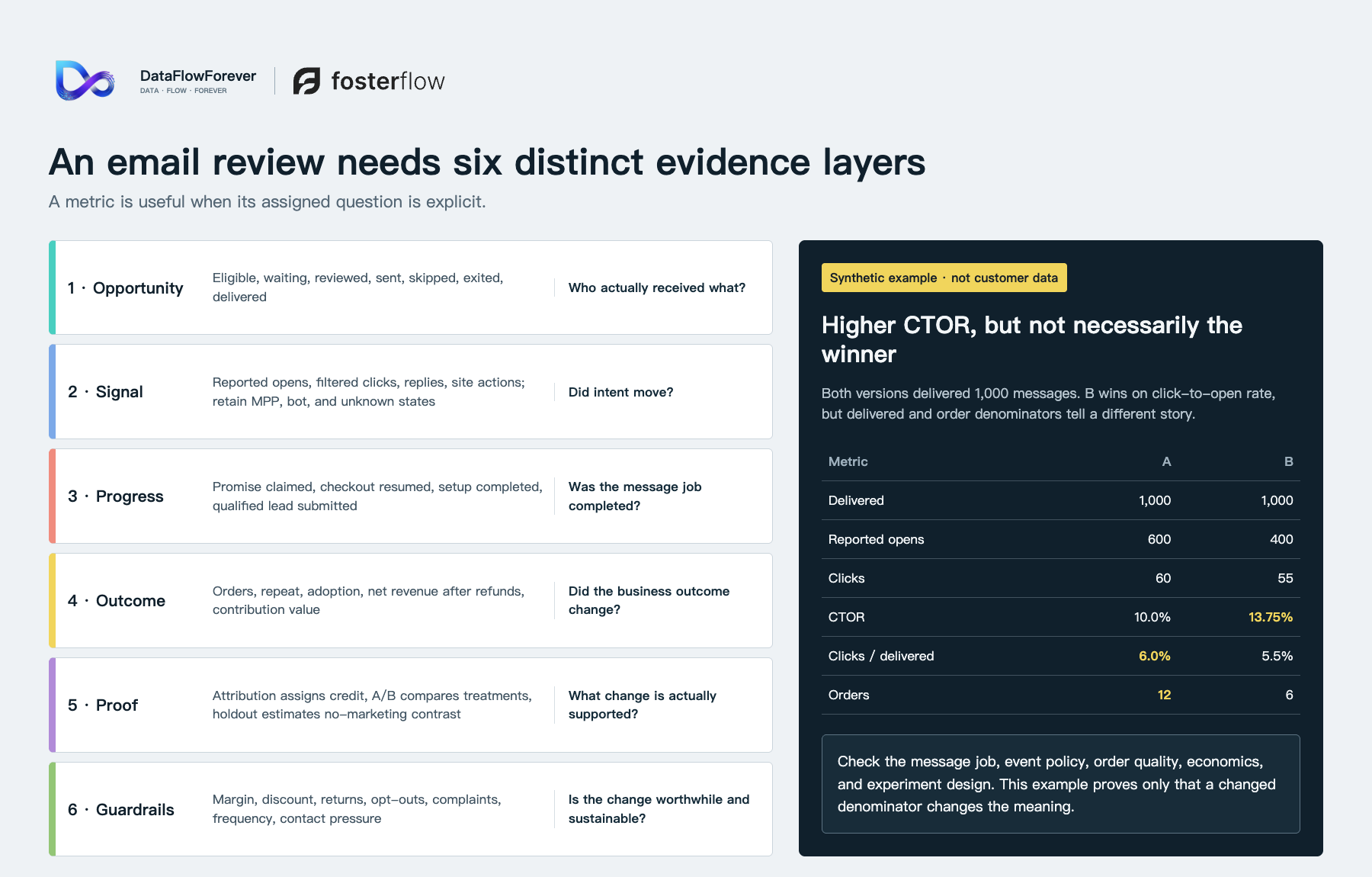
Here is a synthetic example, not merchant or FosterFlow data.
Both versions deliver 1,000 messages:
- A records 600 reported opens, 60 clicks, and 12 orders.
- B records 400 reported opens, 55 clicks, and 6 orders.
B has the higher click-to-open rate: 13.75% versus 10%. A has the higher delivered click rate: 6% versus 5.5%, and twice the observed orders.
The example does not prove that A should win. Assignment, order value, refunds, discounts, and uncertainty are missing. It shows why click-to-open rate can rise when measured opens shrink even if clicks and orders decline.
For every reported rate, preserve:
- raw numerator;
- denominator;
- eligible population;
- event and signal policy;
- observation window;
- decision role.
Small stores should display counts as prominently as rates. A zero-order send means no qualifying order was observed under the current policy. It does not identify one cause or establish zero underlying demand.
6. Locate the first failed customer transition
Trace one population from opportunity to net value. The first material break narrows the owner and next test.
Eligible profiles do not reach send or delivery
Inspect consent, reachability, suppression, purchase exits, competing journeys, contact pressure, event freshness, inventory, and send-time eligibility. Copy has not received a fair test yet.
Delivery is stable but credible action is weak
Inspect acquisition-promise continuity, customer-stage fit, message value, product facts, one clear primary action, link operation, and mobile rendering. Also check whether the reported engagement policy or audience mix changed.
Credible visits occur but Shopify progression stops
Inspect message-to-page promise match, offer fit, price, shipping, product evidence, inventory, trust, speed, forms, payment, and checkout. The email should not absorb every post-click failure.
If the symptom is store-wide traffic with few or no orders, use Shopify Traffic but No Sales? Find the First Broken Step to validate measurement, traffic intent, the offer, product-page progression and checkout before treating the gap as an Email problem.
Orders occur but net value remains weak
Inspect discount cost, net revenue, refunds, returns, product margin, fulfillment, and support. Platform-attributed revenue is not contribution profit.
Choose one local hypothesis at the first supported break. Change one meaningful factor when possible. Record the owner, primary outcome, guardrails, and retest condition.
7. Reconcile email attribution with Shopify order facts
Shopify and an email platform can disagree because they use different identities, touchpoints, order times, windows, models, refund treatment, or recalculation rules. A larger email-platform number is not automatically false, and it is not automatically the business truth.
Start with the canonical order or selected conversion fact:
- conversion ID and type;
- event time, amount, currency, and current order state;
- refund, cancellation, and reversal status;
- permitted identity, device, session, and touchpoint evidence;
- missing, duplicate, late, or conflicting data.
Then apply one disclosed policy to the covered touchpoints. Record the model, window, mapping, identity rule, policy version, eligible touches, excluded touches, credit, and no-credit reason. Every in-scope conversion should be explainable, including unattributed or insufficient-data outcomes.
Use the email platform’s own attributed revenue for within-channel trend diagnosis when its settings and definitions remain stable. Do not add self-attributed totals from email, paid media, affiliates, and other platforms and call the sum incremental revenue.
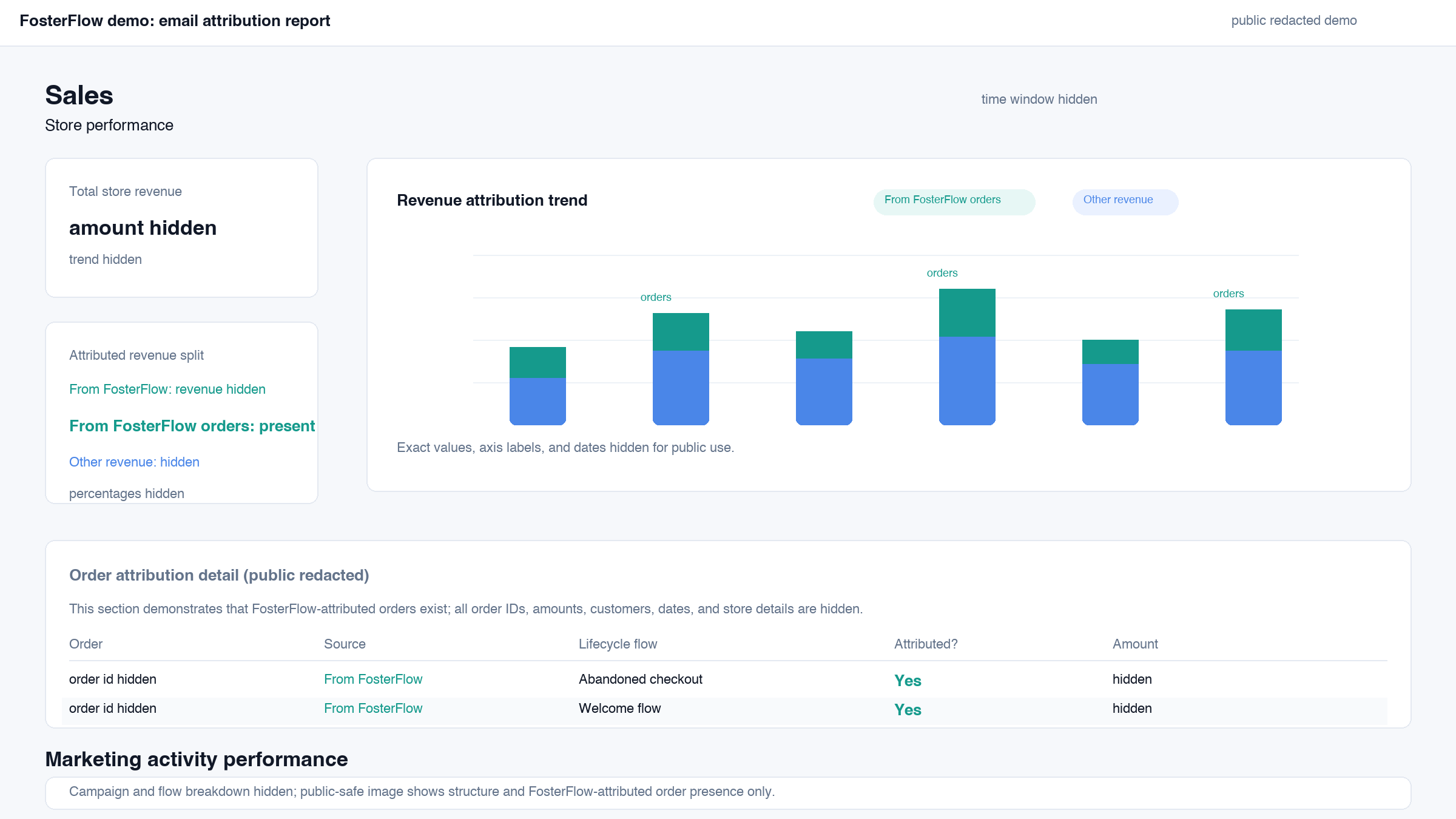
The FosterFlow screenshot above shows a point-in-time attribution-report structure with values hidden. It does not prove current UI parity, attribution accuracy, complete source coverage, merchant outcomes, or causal lift.
8. Match the proof method to the question
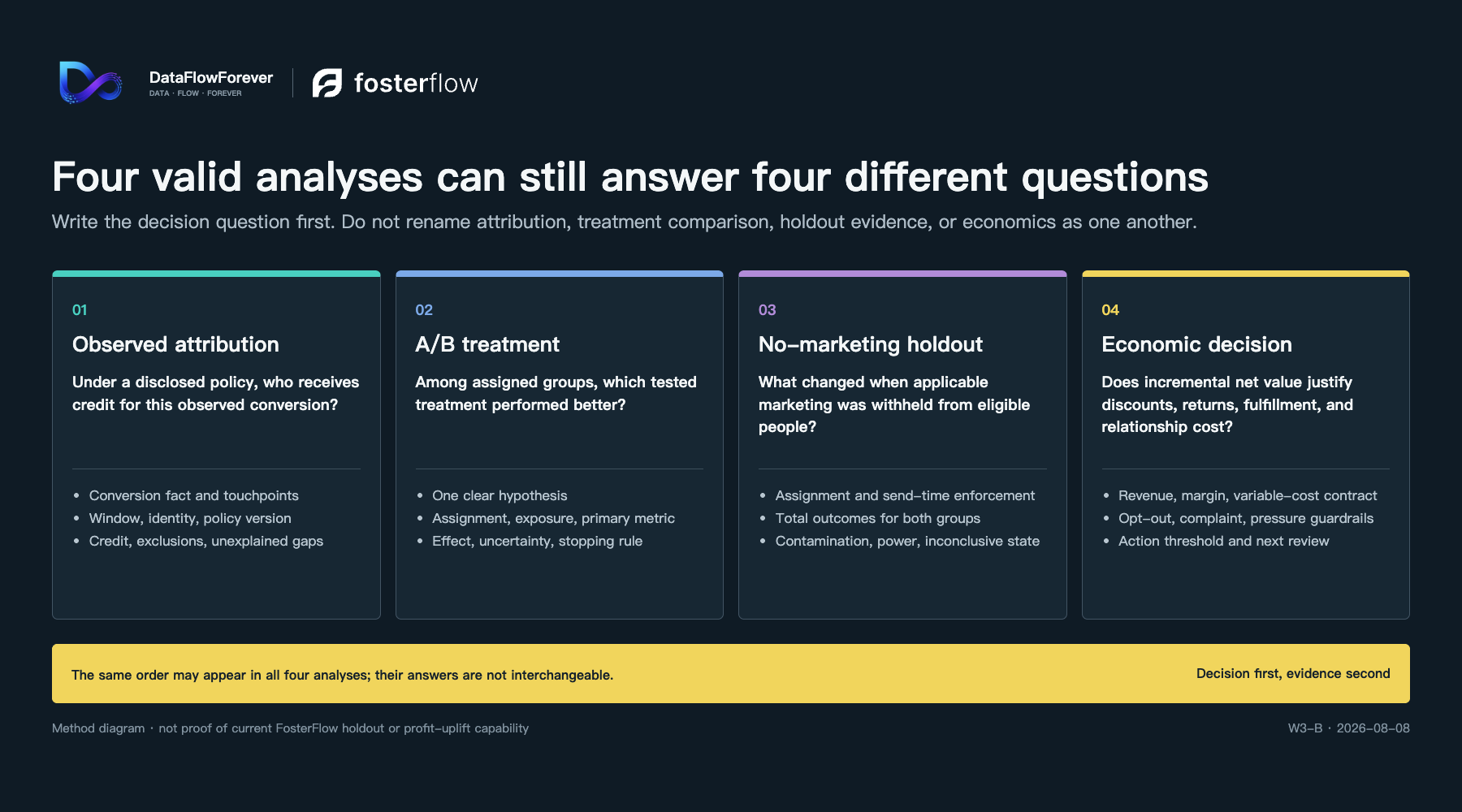
Four useful analyses can include the same Shopify order and still answer different questions.
Observed attribution
Which covered touch receives credit under the disclosed policy? This supports reconciliation and operating views, not the counterfactual.
A/B treatment comparison
Which randomized eligible treatment performs differently on the predeclared outcome? Define the hypothesis, assignment, one main treatment difference, minimum useful effect, window, signal policy, stopping rule, and guardrails before inspecting results.
No-marketing holdout
What changes when an eligible group receives no applicable marketing? A credible design requires persistent membership, send-time enforcement across in-scope Campaigns and Flows, governed transactional or service exceptions, total outcomes, and contamination and uncertainty reporting.
Economic decision
Does any estimated incremental value cover discount, refund, return, fulfillment, and relationship cost? More attributed orders do not answer this question.
Random assignment reduces selection bias but does not guarantee enough precision. Lewis and Rao documented that even very large digital-ad experiments could produce imprecise ROI estimates. In a separate online-shop application, Baier and Stoecker showed a treatment that increased response and revenue under the study setup while reducing simplified profit. Neither result is a Shopify benchmark. Together, they show why a valid review may end with insufficient evidence and why the outcome must be chosen before the result is visible.
Current FosterFlow public evidence does not establish a complete global-holdout runtime, governed MPP classification controls, normalized recipient-level skip audit, arbitrary conversion-property drilldown, or profit-uplift targeting. These are explicit improvement directions, not current feature claims.
Add relationship and economic guardrails
Track the selected outcome beside:
- net revenue, discount, margin, refund, return, and fulfillment where available;
- bounce, complaint, unsubscribe, and suppression;
- delivered messages and exposures per person;
- customer source, lifecycle job, product group, and contact pressure;
- unresolved service or order states that should pause marketing.
An unsubscribe is an enforced state change first and a diagnostic signal second. It can be healthy self-selection or evidence that the acquisition promise, message job, frequency, or treatment failed. Review it by cohort and delivered exposure rather than applying one universal threshold.
Copy this Shopify email result-review worksheet
For one Campaign or Flow, record:
- Job: What should the customer complete now?
- Population: Who qualified, and which exclusions apply?
- Version: Which message, offer, page, and Flow rules ran?
- Window: Which send, event, order, and refund periods apply?
- Lineage: How many were eligible, waiting, sent, skipped, exited, and delivered?
- Signals: Which open, click, reply, and site-event policies apply?
- First break: Which transition weakened first?
- Outcome: Which Shopify order, repeat, adoption, net-value, or lead state governs the job?
- Proof: Attribution, self-comparison, A/B, holdout, or insufficient evidence?
- Guardrails: Which economic and relationship costs remain visible?
- Action: Who changes one thing, and what result will decide whether to keep it?
- Retest: When will the team review again?
This record turns a dashboard review into reusable operating knowledge. It also prevents the team from solving a checkout problem with another subject line or treating a measurement-policy change as customer behavior.
Shopify email performance FAQ
What is a good Shopify email open rate?
There is no universal rate that can diagnose a store. Audience source, lifecycle job, sender and delivery state, Apple MPP, event policy, message type, and denominator all affect the result. Compare sufficiently similar sends with raw counts and a stable policy, then reconcile the intended downstream outcome.
Should Shopify merchants optimize for opens or clicks?
Optimize for the customer or business job. Opens can diagnose a subject treatment under a declared MPP policy. Filtered clicks or site actions can diagnose message and CTA. Orders, qualified actions, successful use, net value, or another downstream result should govern the job they represent.
Why is email revenue different from Shopify revenue?
The systems may use different attribution windows, identities, touchpoints, order times, models, refunds, and recalculation rules. Reconcile at the order or conversion level, keep one disclosed cross-channel policy for company decisions, and retain the platform view for stable-definition email trend analysis.
Does an A/B test prove incremental email revenue?
An A/B test can compare two treatments among eligible recipients. It does not automatically compare marketing with no marketing. A governed holdout is designed for that question, and either experiment can remain inconclusive when assignment, enforcement, sample, variance, outcome coverage, or contamination is insufficient.
Continue the audit
Use How to Audit Shopify Email Flows to review entry, handoff, exit, and send-time eligibility. Then check Shopify Customer Segmentation and Message Eligibility and How to Stop Abandoned Cart Emails After Purchase for two narrower execution problems.
Start with one real Campaign or Flow. Follow the same eligible profiles to the selected Shopify outcome, preserve the evidence boundary, and change the first transition that actually failed.
Product evidence note
The FosterFlow screenshots in this article are approved public-safe, point-in-time demonstrations. They support discussion of lifecycle and attribution reporting structure. They do not prove current UI parity, live execution, event freshness, delivery, attribution accuracy, customer results, holdout integrity, or incremental profit.
The two editorial diagrams are method visuals, not FosterFlow interfaces or merchant data. The numerical example is explicitly synthetic. Every text-bearing image selected for this FosterFlow Blog draft is English-only.
References
- Apple: Use Mail Privacy Protection on iPhone
- Klaviyo: Understanding bot clicks
- Klaviyo: Understanding unique versus total opens and clicks
- Shopify: Marketing reports
- Google Analytics: About modeled key events
- Randall A. Lewis and Justin M. Rao, The Unfavorable Economics of Measuring the Returns to Advertising, DOI 10.1093/qje/qjv023
- Daniel Baier and Bjorn Stoecker, Profit uplift modeling for direct marketing campaigns, DOI 10.1007/s11573-021-01068-3
2 thoughts on “How to Measure Shopify Email Performance Beyond Open Rate”