
Shopify Traffic but No Sales? Find the First Broken Step
Your Shopify dashboard shows traffic. Your Campaigns earn clicks. Your Flows are active. The order line still looks quiet.
Getting traffic but no sales does not point to one universal fix. First confirm that the traffic is real and relevant. Then find the first step that weakens: product view, Add to Cart, checkout, or purchase.
At this point, it is tempting to add another abandoned-cart email, increase the discount, install a conversion app or redesign the product page. Each action feels concrete. The trouble is that “traffic but no sales” does not tell you which one belongs next.
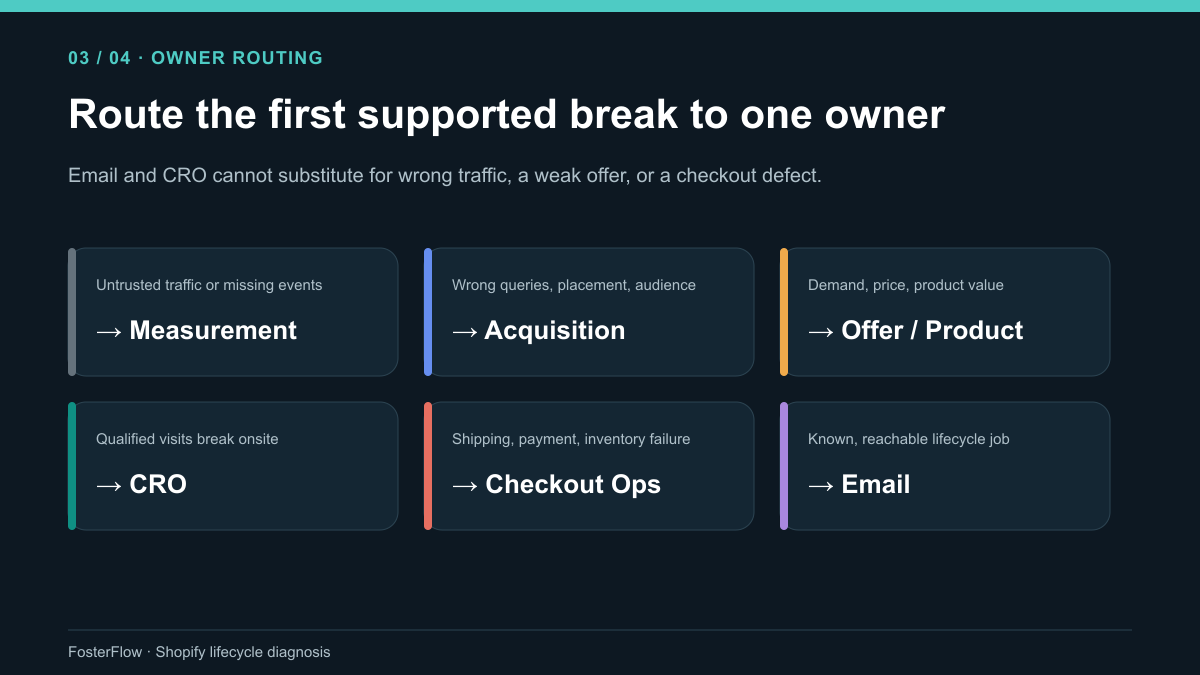
The same symptom can begin with inaccurate sessions, low-intent media, a product or price that does not fit the visitor's job, a broken promise between message and page, onsite friction, shipping or payment failure, or a buying cycle that has not matured. Email can help some of those customers. CRO can help some of those visits. Neither should become the default diagnosis.
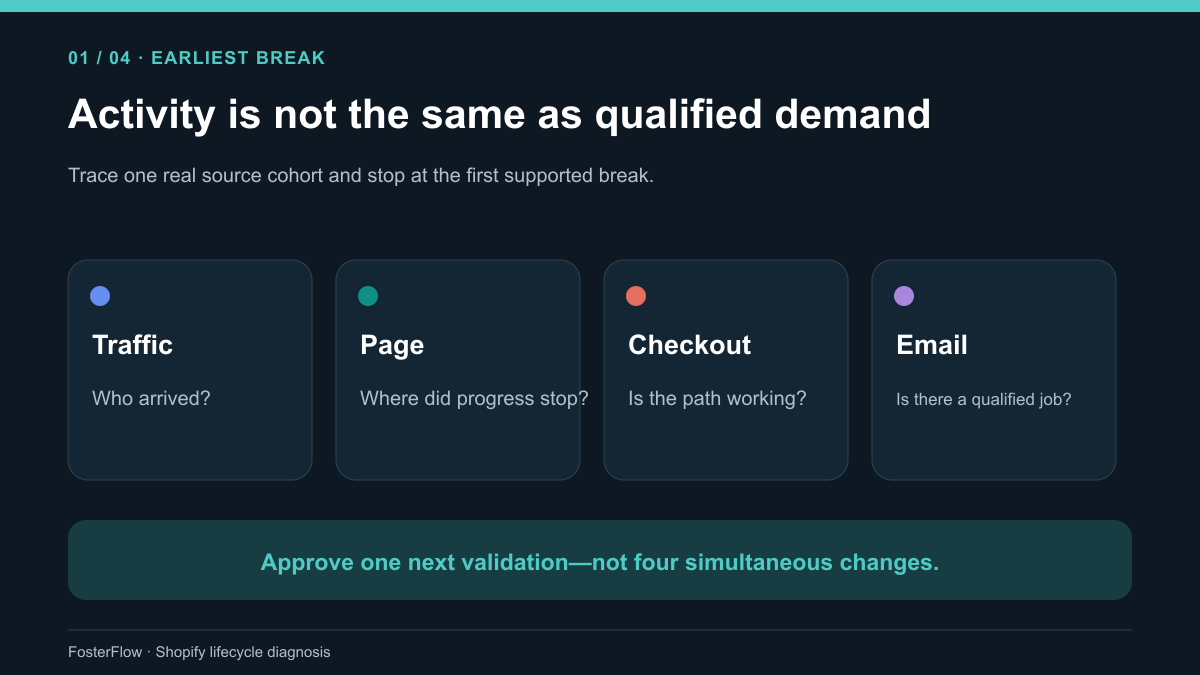
The useful question is: where did this specific buyer cohort first stop making credible progress?
Choose one source and window. Follow it from traffic truth through the product page, cart and checkout. Preserve lifecycle eligibility when a person becomes known. Stop at the first break supported by evidence, then give one owner the next validation.
Shopify traffic but no sales: start with one cohort
A store-wide conversion rate mixes people who arrived for different reasons. Paid search, paid social, creators, organic content, direct visits, returning customers and automated traffic can share one denominator while facing different pages, promises and buying cycles.
Begin with a cohort narrow enough to answer a decision. It might be one Search campaign and its actual queries, one Meta objective and landing page, one email Campaign version, or one cart-recovery Flow. Record the primary conversion unit and an observation window that fits the product. A high-ticket product with a longer decision cycle should not be judged like an impulse purchase.
Then decide whether the measurement can support the question. Shopify documents how acquisition reports and bot filtering work. It also documents that analytics can differ when consent, device behavior, source data or report definitions differ. Those mechanisms are useful, but they do not make every session a buyer or every unattributed order disappear from the business.
If a referrer, geography or device produces a large session spike without matching exposure, spend, product events, checkout attempts or orders, preserve both the raw count and any approved classification. Compare the source with the downstream event sequence. When the evidence does not cohere, Measurement owns the next action. Do not redesign a product page around an untrusted denominator. Do not try to capture those anonymous sessions into Email merely to make them measurable.
Avoid universal filters. A short session is not automatically a bot; a long session is not automatically engaged. A platform label can help classify known automation, but it is not proof that all remaining traffic represents qualified demand. Use measure-only when event truth is the earliest break.
Check whether the source brought a buying job
Campaign performance can look healthy at the top while optimizing for the wrong outcome.
For Google Ads, inspect actual search terms. A configured keyword can trigger questions about tutorials, jobs, free downloads, support or research alongside commercial comparisons. For paid social, inspect the objective, placement, geography, device, creative and destination. A strong creative may earn curiosity clicks while hiding the product category, price range or eligibility that would filter for the right people.
CTR measures a response to the ad. It does not prove that the person wanted to buy this product from this store.
Ask what the source promised and what the visitor saw first. If the ad leads with a specific model, use case, availability condition, delivery promise or bundle, the landing page should preserve it. A person should not have to restart the search after the click. This is sometimes called message match or scent, but the practical job is simple: keep the same product, condition, value and next action visible.
If the queries, objective or placements clearly bring irrelevant jobs, Acquisition owns the correction. Preserve the landing-page evidence, but do not make CRO compensate for an audience that should not have been there. Media changes require the appropriate account approval.
Decide whether the offer can carry the promise
Suppose the traffic is plausible and the landing page matches the ad. The product still needs a reason to win the decision.
What use case does it serve? Who values that outcome? What are the credible alternatives? How do price, bundle, shipping, returns and delivery timing change the choice? Why buy directly now instead of returning to a marketplace or familiar brand?
These are Offer/Product questions. Reviews, photography and clearer copy can help communicate the answer, but presentation cannot create demand that has not been established. If a product sells on Etsy and does not sell from cold Shopify traffic, you have evidence that the marketplace context works differently. You do not yet have proof that the direct-store page caused the result or that the product has been validated across channels.
Keep offer substance separate from page expression in the hypothesis register. One hypothesis can address product, use case, price, bundle, objections and economics. Another can address whether a qualified visitor understands and acts on the offer. If the test changes both at once, disclose that confounding and keep the conclusion narrow.
Email can contribute objection evidence from permissioned customers. A reply, click pattern or support theme may show what people need clarified. It does not turn Email into the owner of price, product quality or market demand.
Let CRO diagnose a page transition after the upstream gates pass
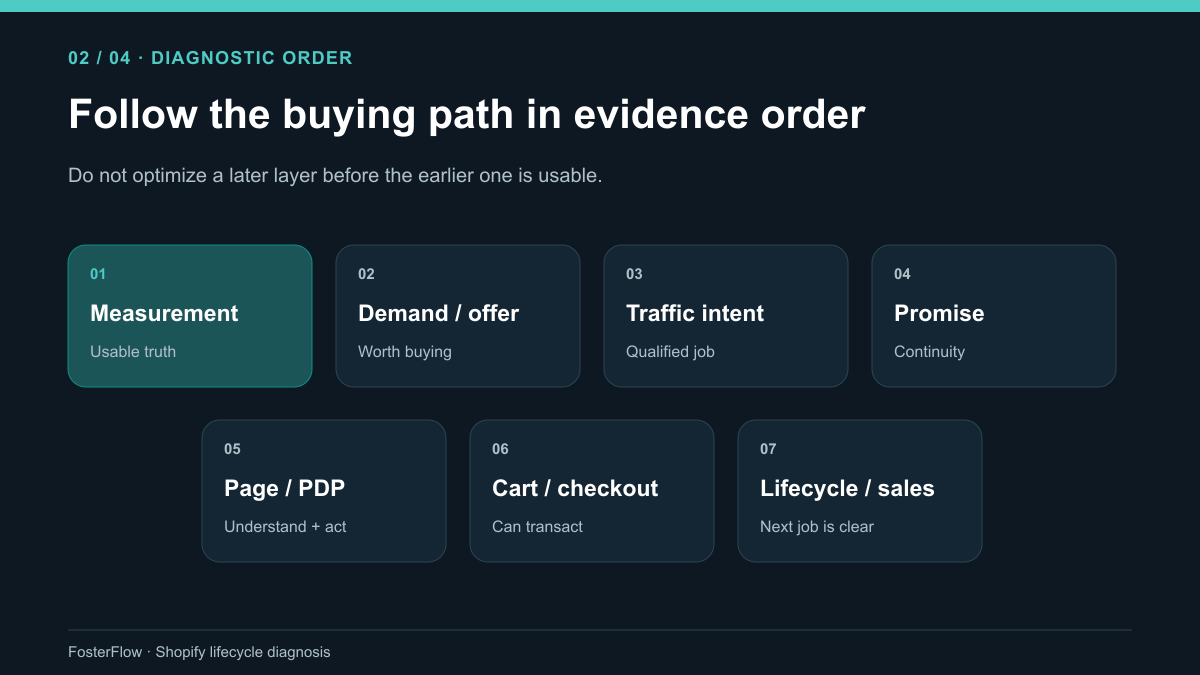
CRO becomes useful when measurement is usable for the decision, traffic has plausible intent, the offer is explicit, and a page or transaction transition can be located.
On a Shopify product page, inspect understanding, trust and action for the same cohort:
- Does the first viewport preserve the source promise?
- Can the visitor confirm product fit, variants, included items and availability?
- Are price, shipping, returns and delivery conditions visible at the moment they matter?
- Is authentic proof relevant to the selected product and claim?
- Does mobile interaction expose the same essential information and primary action?
- Does Add to Cart create a valid cart with the selected state?
- Do cart, product page and policy statements agree?
Heatmaps, session recordings and funnel segments can help locate a candidate. They do not establish cause by themselves. Low interaction can still reflect event loss, irrelevant traffic or an unsupported offer. A segment difference is observational evidence until a suitable comparison is designed.
Use fix-now for a verified defect: a dead control, missing required disclosure, mobile obstruction, confirmed tracking failure or demonstrably irrelevant acquisition rule. Keep before-and-after evidence and the approval record.
Use test for an uncertain behavioral hypothesis. Define the eligible population, concurrent randomized allocation by default, one primary manipulated variable, outcome window and buying-cycle allowance. Freeze the signed direction, minimum business-material effect, numeric decision threshold, stop condition and guardrails before exposure or result access. Include economics such as contribution, AOV, refunds and cancellations, plus relationship costs such as unsubscribes, complaints and customer quality. A higher point estimate is not automatically a winner.
When the population is small or cycles are incomplete, use insufficient-evidence. Do not create a fixed Shopify session count or test duration to avoid making that decision.
Treat cart and checkout failures as operations before recovery
If qualified visitors view products and create carts normally, then drop after checkout starts, the earliest observable break has moved. It still needs a cause.
Inspect shipping options, taxes, currency, inventory, discounts, address rules, payment methods, 3DS, gateway responses and visible errors. Reconcile payment attempts with orders. Segment only when geography, device, product or shipping choice can change the decision. Reproduce the problem when possible.
A verified payment, shipping or configuration failure belongs to Checkout Operations. CRO may help with interaction and explanation, but an operational defect is not a button experiment.
Recovery Email is secondary. The person must be identified and eligible. The message should return them to a working path, preserve the right product or checkout state and address a supported objection. Do not assume that every abandonment requires a discount. Do not keep sending people into a broken payment or shipping rule.
If the reason for abandonment is unknown after checkout start, keep Checkout Operations as the validation owner and use measure-only. An attributed order after a reminder can be useful observed reporting. It does not prove that the reminder fixed the defect or created the full incremental result.
Give Email a specific lifecycle job
Email is useful when three conditions are true:
- The person is identified and legally and operationally contactable.
- Their lifecycle state and eligibility are known well enough for the message.
- The message has a clear customer job and a downstream outcome.
Welcome can fulfill the signup promise and support an initial decision. Education can answer an evidenced objection. Cart or checkout recovery can remind a person with continuing intent after operational defects are ruled out or bounded. Post-purchase communication can support delivery and use. Replenishment, repeat purchase, retention and reactivation serve established customer relationships.
Each path needs entry, exit, suppression, frequency and outcome rules. Opens and clicks describe parts of the path; they do not prove purchase intent or business success.
When Email clicks are healthy but the landing action is weak, validate the click-to-landing event path. Then check the message job and promise. If the message offered the wrong next step for the customer's state, Email owns the correction. If the promise relies on an unsupported product or price, Offer/Product owns it. If events do not reconcile, Measurement owns it. If the same qualified cohort encounters a local page break, CRO owns the next validation.
This handoff is more useful than saying “Email worked” because the click rate is high or “the page failed” because orders are low.
For the Email-side evidence, use How to Measure Shopify Email Performance Beyond Open Rate and How to Audit Shopify Email Flows. They answer narrower lifecycle questions after Email has a qualified job.
What FosterFlow should preserve in this diagnosis
FosterFlow is a Shopify-first lifecycle and email operating surface. Within current product and implementation boundaries, it can organize customer, order, product, post-install onsite behavior, profile and subscription or suppression state; it can support dynamic and static audiences, Campaigns, visual Flows and result review. Exact availability depends on the current product, permissions, data and project conditions.
In this diagnostic, its job is to preserve lifecycle evidence:
- who was identified and eligible;
- which Segment, Campaign or Flow state applied;
- what message and destination were used;
- what downstream actions and orders were observed;
- which suppression, unsubscribe, complaint, refund or customer-quality guardrails matter;
- when the evidence should hand off to Measurement, Acquisition, Offer/Product, onsite CRO or Checkout Operations.
That boundary keeps automation honest. FosterFlow should not be described as creating demand, qualifying anonymous traffic by itself, repairing payment behavior, proving incrementality from attribution alone or guaranteeing conversion improvement.
Use one owner record in the next review
For one important cohort, write:
- decision question, merchant type, primary conversion unit and observation window;
- measurement confidence;
- earliest observable break;
- one primary owner;
- hypothesis evidence, counterevidence, status, confidence and missing data;
fix-now,test,measure-only,holdorinsufficient-evidence;- next action, metric, window, stop condition and approval.
An irrelevant search-term cohort routes to Acquisition. A reproducible mobile PDP-to-cart defect routes to onsite CRO. Normal cart creation followed by verified shipping failure routes to Checkout Operations; permissioned recovery remains secondary. Healthy Email clicks with a validated page break route to CRO. A referrer spike without spend or downstream coherence routes to Measurement. A small high-ticket cohort with unfinished buying cycles stays insufficient-evidence.
The goal is not to make every team busy. It is to make the next proof clear.
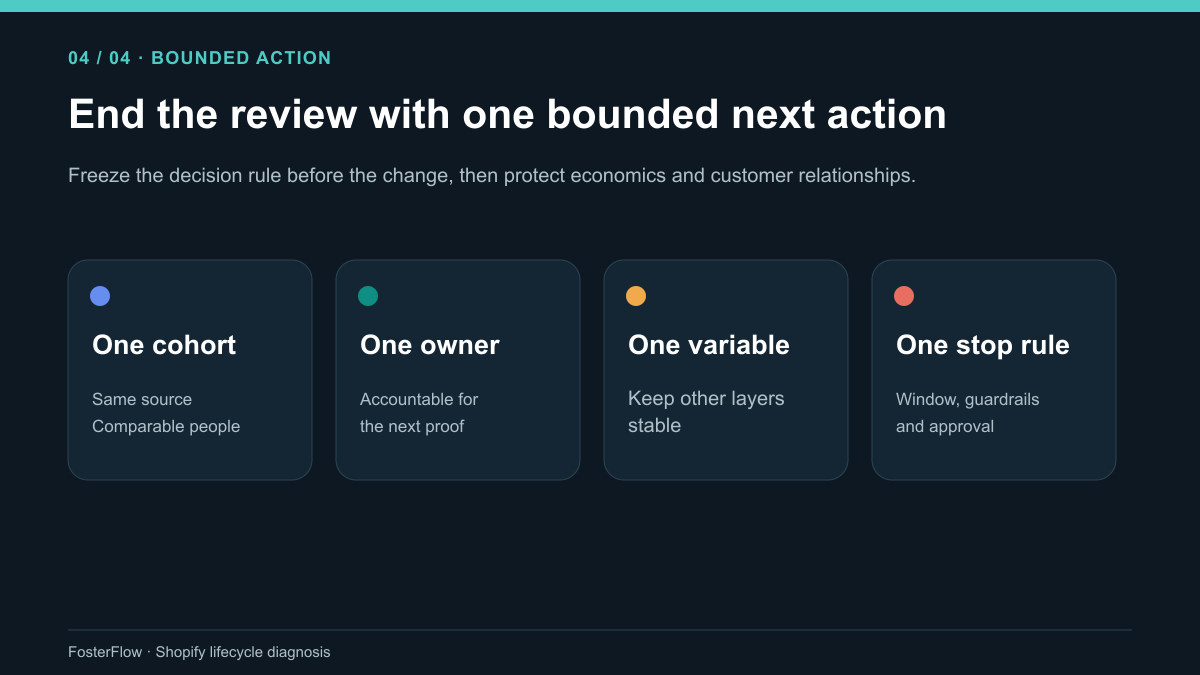
Keep economic and relationship guardrails beside the order metric
A conversion improvement can still be the wrong decision. A discount may increase attributed orders while reducing contribution, attracting low-quality customers, increasing refunds or teaching repeat buyers to wait. A more aggressive recovery sequence may earn clicks while raising unsubscribes, complaints or support demand.
Write those guardrails before the change. Select the economic outcome that matches the decision, preserve refund and cancellation windows, and compare customer quality on a realistic horizon. For lifecycle messages, include suppression and exposure so one customer is not treated as several independent opportunities.
When the primary outcome and guardrails disagree, classify the result as contradictory rather than selecting the metric that favors the treatment. When the estimate remains too imprecise to support the minimum useful effect, use insufficient-evidence. This is especially important for small Shopify cohorts, seasonal products and long repeat-purchase cycles.
FosterFlow result review can contribute observed Campaign, Flow and downstream evidence within the data and attribution rules in scope. It should not silently upgrade observed credit into incrementality or profit proof. The decision record remains responsible for the comparison design and economic definition.
Shopify traffic but no sales FAQ
Why is my Shopify store getting traffic but no sales?
The symptom can begin with untrusted measurement, low-intent traffic, a weak or unclear offer, product-page friction, a checkout defect, or an incomplete buying cycle. Confirm one source cohort and stop at its first supported break before choosing a fix.
How do I tell whether the traffic or product page is the problem?
Check what the source promised and whether the arriving cohort was plausibly shopping for that product. If the queries, placement, objective, geography, or creative attract the wrong job, Acquisition owns the correction. If qualified visitors understand the offer but consistently fail at a reproducible page transition, CRO becomes the next validation owner.
Should I add more abandoned-cart email when sales are low?
Only when shoppers created a cart or started checkout, are identified and eligible to receive the message, and the transaction path is working. A recovery message cannot repair wrong traffic, missing demand, or a verified payment or shipping defect. For the purchase-exit case, see How to Stop Abandoned Cart Emails After a Shopify Customer Purchases.
When is CRO the right next step?
CRO is useful after measurement is usable, traffic has plausible intent, the offer is explicit, and the same cohort shows a local page, product-page, cart, or interaction break. If those prerequisites are not supported, keep the result as measure-only or insufficient-evidence and route the next proof elsewhere.
Sources and limits
This guide synthesizes 22 Reddit question-and-answer discussions, 20 X discussions, six official sources and three independent research sources. Community material was used for voice, hypotheses, conflicts and counterexamples. We did not use usernames, copied comments, popularity, universal conversion-rate targets, fixed duration filters or unverified lift claims.
Official mechanism references include Shopify Acquisition reports, Shopify bot filtering, GA4 acquisition scope, Google Ads Search terms and Google's ad-to-landing guidance. They explain mechanisms; they do not diagnose a store or promise a result.
If your store has activity across Ads, Shopify and Email but no clear order path, start with one cohort and one owner record. Use the evidence to decide whether Email or CRO has a qualified job—or whether the next proof belongs somewhere else.
2 thoughts on “Shopify Traffic but No Sales? Find the First Broken Step”