
What Repeat Product Views Can—and Cannot Tell Shopify Merchants Before Checkout
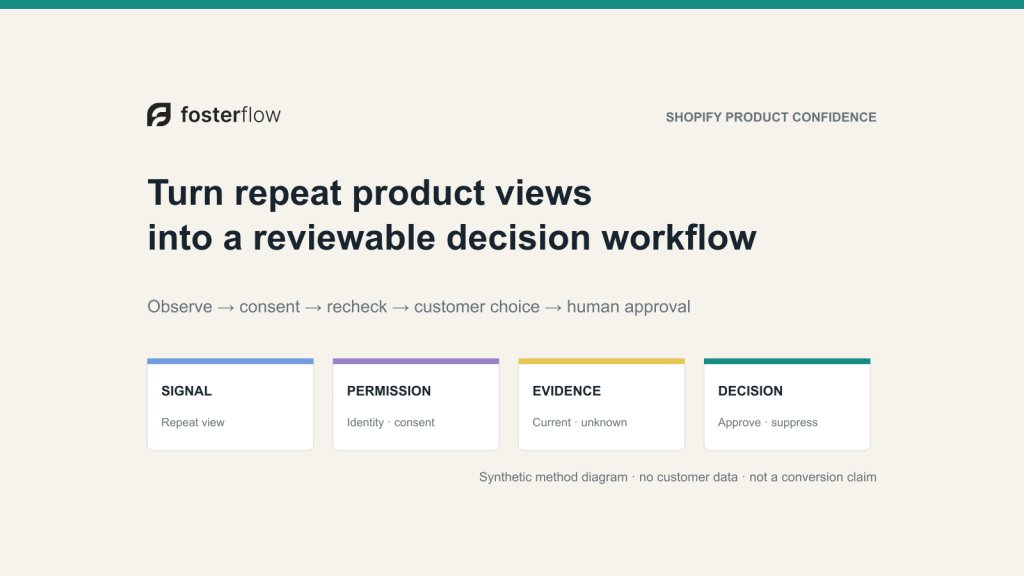
The same product page records views on Tuesday, Thursday, and Saturday. Under its defined identity rules, the Shopify lifecycle team sees repeat-view activity and no connected purchase in the chosen window. Someone proposes a message: “Still worried it won’t fit?”
That sentence crosses a line the data did not cross.
The recorded behavior may be accurate. The explanation is not observed. The shopper could be comparing dimensions, checking compatibility with something they own, waiting for a delivery date, forwarding the link, looking for test conditions, or simply postponing a decision. They may have reached a conclusion that requires no further contact.
Repeat product views are therefore a useful workflow trigger, not a diagnosis. Their value is operational: they can prompt a Shopify team to check whether an eligible person can be offered a current, verifiable next step. They do not grant permission to narrate the person’s inner state.
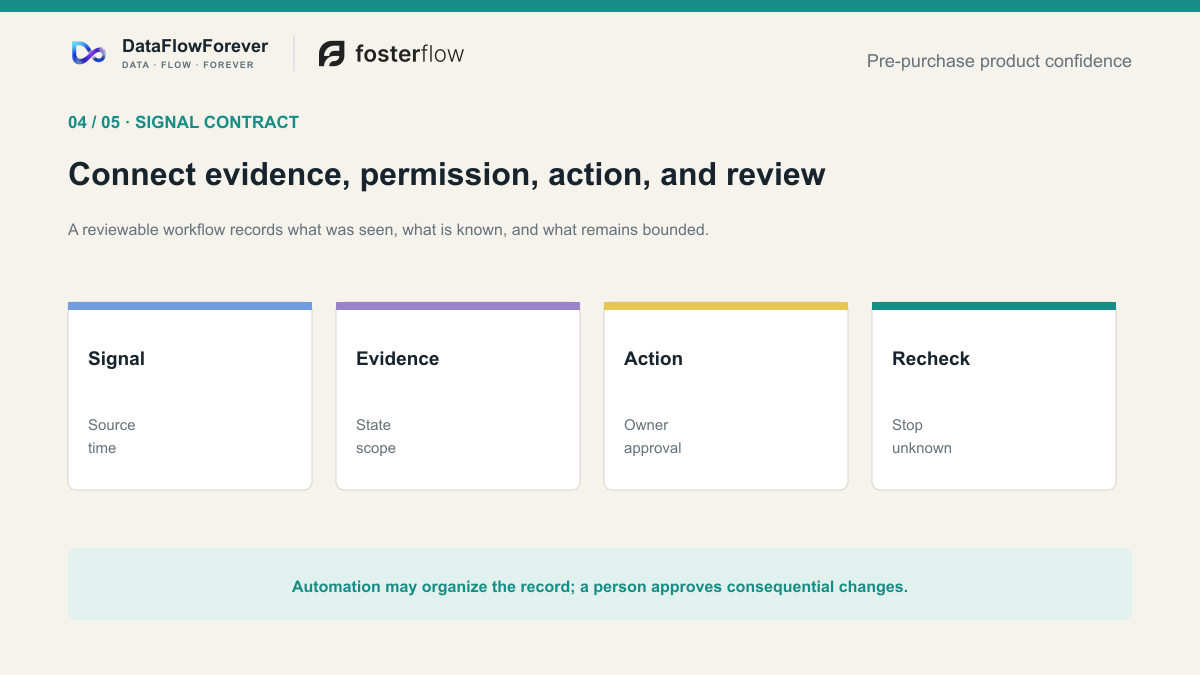
This distinction leads to a different kind of lifecycle design. Instead of moving directly from event to message, the workflow passes through identity and consent, current product state, a declared message job, an explicit customer choice, an evidence route, and a human approval or suppression decision. “Send nothing” and “change nothing yet” are both valid outcomes.
Start with the observation, not the story
Suppose the available record says that an identified profile viewed one product twice in seven days and that no purchase event is connected to that profile during the same period. Even this simple sentence has boundaries. The implementation must define what counts as a view, which product and variant identifiers are retained, how identities are joined, which stores or channels contribute purchase data, and when the window closes.
If those conditions hold, the team may know:
- a recorded profile viewed a declared product or variant;
- the events occurred at particular times;
- no connected purchase was observed within a stated data scope and window; and
- the profile is currently eligible or ineligible for a particular communication.
The team still does not know why the person returned, whether all sessions belong to the same person, whether they noticed a specific page section, whether a concern exists, or whether a future order would be caused by a follow-up.
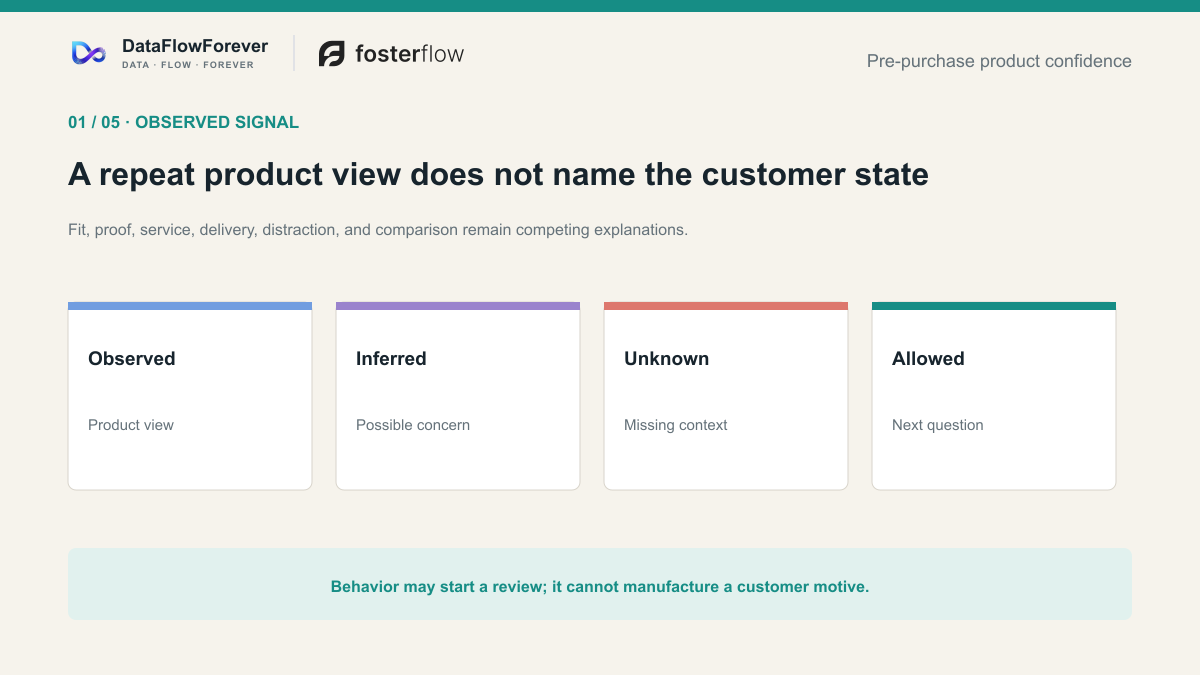
This is why segment names matter. “Sizing hesitators” turns a hypothesis into a customer attribute. A defensible internal label is more literal: “eligible profiles with repeat views of products in scope and no observed purchase in the declared window.” The customer never needs to see that cumbersome label. The team does, because it prevents a Flow from saying more than its inputs support.
Keep the evidence matrix compact
The lifecycle workflow does not need to recreate the whole product page. It needs to know which customer decision it can help with, what source supports the answer, and what to do when the answer is unavailable.
| Decision class | Minimum evidence route | If the state is unknown |
|---|---|---|
| Compatibility | Exact product and variant, object being matched, conditions, exclusions, source, version, verification date | Ask for the missing model or route to a qualified confirmation owner |
| Personal fit | Item measurements, measurement method, material and model context, comparison or trial path | Offer a guide or trial route without predicting “right for you” |
| Performance | Tested variant, method, sample, conditions, unit, date, provenance, limits | Remove the unsupported summary or request evidence from the claim owner |
| Reviews | Contributor eligibility, verification meaning, incentives or relationships, moderation, sorting, product version, collection date | Explain what is not established; do not convert a badge into proof |
| Warranty and service | Covered product, term, exclusions, proof required, remedy, parts and service route, region, current date | Show the applicable terms or send the question to the accountable service owner |
| Price and delivery | Variant, market, total required price, offer conditions, stock or preorder state, handling and transit assumptions | Recalculate from current state or suppress the promise |
These classes answer different questions, but they share one discipline: every short promise should connect to its object, source, conditions, owner, and freshness rule. A concise answer is useful only when the path behind it remains inspectable.
For example, the European Commission’s 2026 consumer guide for covered smartphones and tablets shows how a compact label can connect standardized battery runtime, durability, protection, and repairability information to a model-level EPREL record. The guide also explains that actual battery life varies with use. This is an EU, category-specific example—not proof that any merchant’s claims are correct, and not a template for every product.
Likewise, ISO 20488:2018 frames online consumer reviews as a process involving collection, moderation, and publication. The public abstract supports asking how a review system works; it does not certify a merchant, prove that every review is genuine, or establish purchase impact.
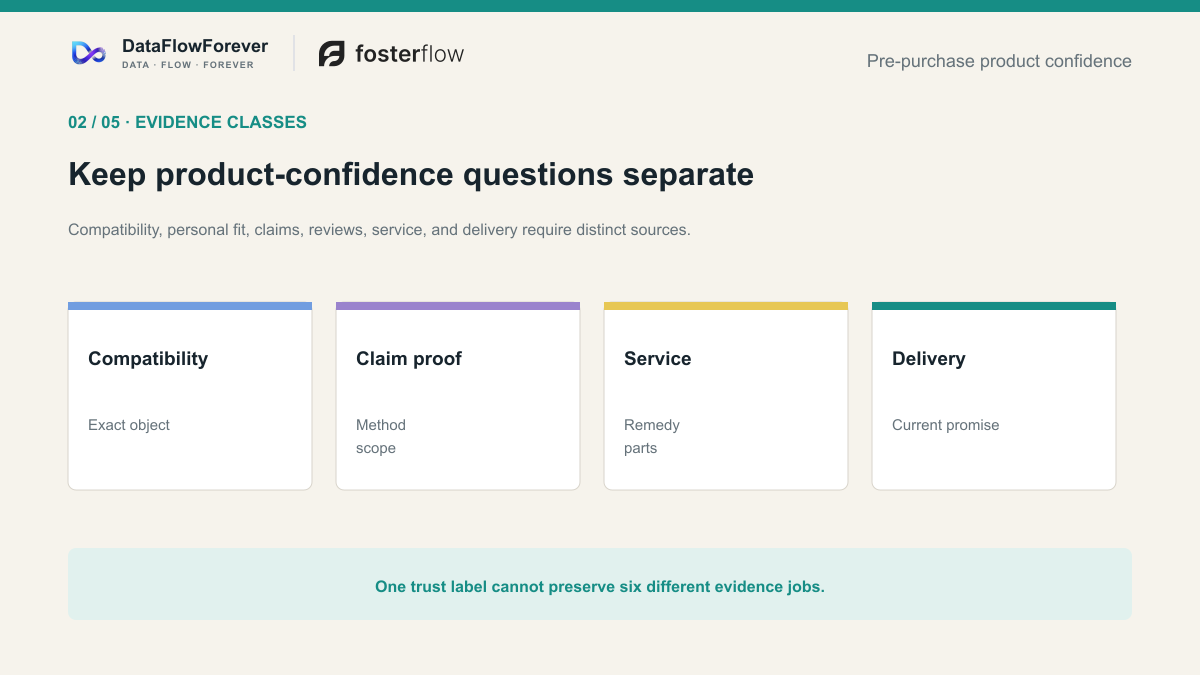
The matrix is deliberately brief. Its job is to stop a lifecycle team from treating a warranty as reliability proof, a delivery estimate as an inventory fact, or a star rating as a universal product conclusion. Once the class is clear, the workflow can choose a narrow and supportable next step.
It also prevents “add more content” from becoming the default treatment. A 2024 study of augmented-reality product presentation used two studies and reported that AR could increase perceived diagnosticity while also increasing perceived cognitive load; product type affected the results. That bounded finding does not predict outcomes for another store or category. It supports a smaller design principle: choose the format for the decision task, then test whether the task became easier.
Design the lifecycle workflow as eight gates
1. Record the repeat-view observation
The entry event should be descriptive. Record the product or variant, event count, window, identity state, and data boundary. Avoid derived labels such as “confused,” “high intent,” or “price sensitive” unless a separate, documented method supports them—and even then, keep model output distinct from observed fact.
The threshold is a workflow choice, not a psychological law. Two views in seven days may be useful for one considered product and noisy for another. A team can start with a bounded product family, inspect event quality, and revise the rule without claiming that the threshold reveals intent.
2. Apply the identity and consent gate
Before composing anything, confirm that the observed profile is connected under the implementation’s identity rules and currently eligible for the intended channel. Consent is not a one-time decoration on the contact record. The send decision should use the current permission state, relevant market and channel rules, suppression status, and frequency policy.
If identity is ambiguous, consent is missing, or the required purpose is not supported, stop. Do not use a persuasive message to compensate for an unresolved data relationship.
For the audience-definition side of this gate, see how dynamic Shopify segments combine consent, reachability, current behavior, and message purpose. That page explains segment eligibility; this article continues into product-evidence routing and approval.
3. Recheck customer and product state
The state that triggered entry may be stale by send time. Recheck whether a purchase has since been observed, the selected variant still exists, its price and availability are current, the claimed evidence remains valid, and destination-dependent statements can be supported.
Visible page copy, machine-readable product data, checkout, and support guidance should describe the same current state. Google’s product structured-data documentation shows that merchant listings can express information such as variants, size, price, availability, shipping, and returns. That makes structured data a useful continuity check. It does not make an incorrect fact true, prove customer understanding, or guarantee search display or business results.
If the product record conflicts with checkout or the evidence is stale, the workflow should pause or suppress. Sending faster would only distribute the inconsistency.
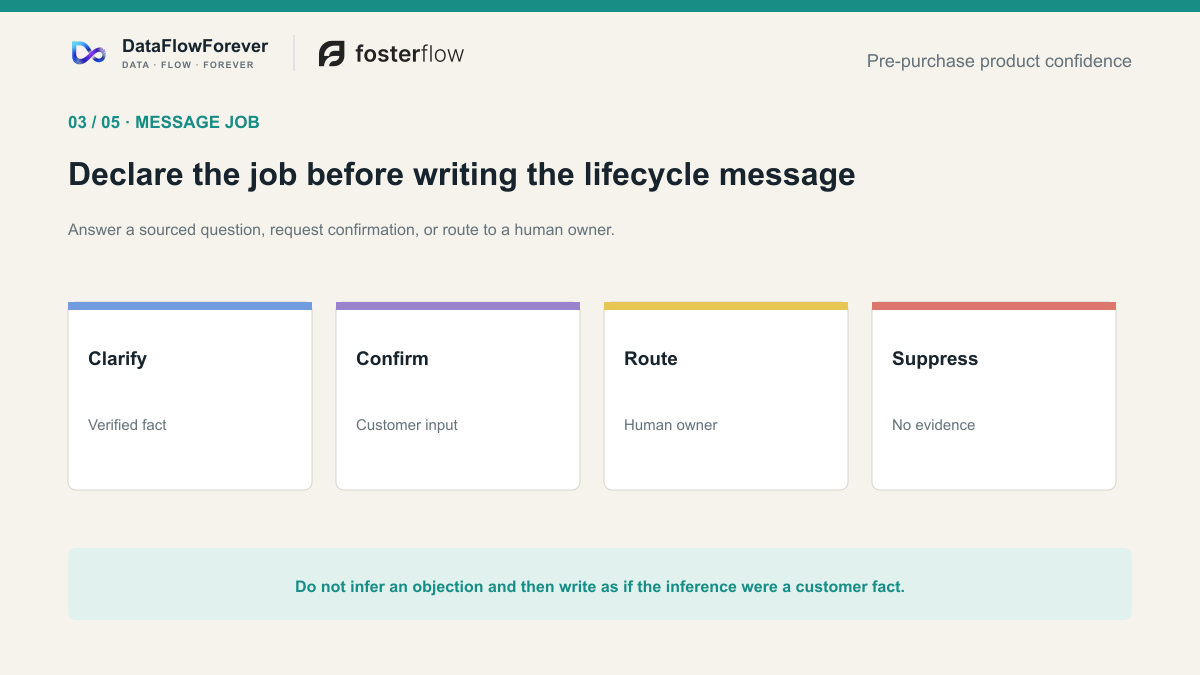
4. Declare one neutral message job
A message job describes what the communication helps the shopper do. It does not describe what the team imagines the shopper feels.
Useful jobs include checking a model-specific compatibility state, comparing item measurements, inspecting the method behind one claim, understanding how reviews are collected, reading warranty and parts terms, or calculating a current arrival range. If the signal cannot distinguish among these jobs, the message can offer a short decision guide.
“Choose the detail you want to check” is supportable. “We know fit is holding you back” is not.
5. Let the customer choose the route
An explicit choice can narrow the next step without pretending to explain the earlier behavior. A message might offer “check compatibility,” “compare measurements,” “see test details,” “review service terms,” or “calculate delivery.” Each route should state what information it will provide.
Treat the selection as a current service request, not a durable personality label. A click on “delivery” means the person chose that route in that moment. It does not prove that delivery caused the repeat views, that the issue is permanently important, or that the answer resolved the decision.
6. Serve evidence—or preserve the unknown
When the chosen route has a current answer, serve the smallest useful summary and link to the underlying method, policy, model record, or confirmation path. When the answer is conditional, show the condition. When it is conflicting, stale, or unknown, keep that state visible and route it to its owner.
Anonymous public discussions reviewed during research offered useful illustrative patterns: an accessory name reused across device generations while adapter requirements remained unclear; a furniture page with polished images but no critical dimensions; and a “lifetime” warranty whose invoice, region, sales-channel, and remedy conditions were hard to find. These are case prompts, not representative statistics, verified brand findings, or evidence of why shoppers did not buy.
The operating lesson is narrow: unknown facts need a route, not fluent copy.
7. Require human approval or suppress
Before a new workflow goes live, define who approves the observation rule, message job, product evidence, wording, exclusions, and freshness policy. Depending on the claim, the approver may come from product, merchandising, support, operations, or compliance. Approval should attach to a version and expire when a material source changes.
A review record can ask:
- Does the message describe an observed event without inventing intent?
- Is the recipient eligible under current identity, consent, and frequency rules?
- Does each factual statement point to current product evidence?
- Can checkout, support, and operations honor the same promise?
- What happens when the answer is unknown or a human cannot respond in time?
- Which change forces reapproval?
If no accountable person can approve the promise, suppress the action. If the page already presents the answer clearly and the message adds no useful task, suppress it. If the team lacks enough volume or event quality to evaluate the workflow, leaving the experience unchanged is reasonable. Automation is not a requirement to communicate.
8. Measure the task before claiming business effect
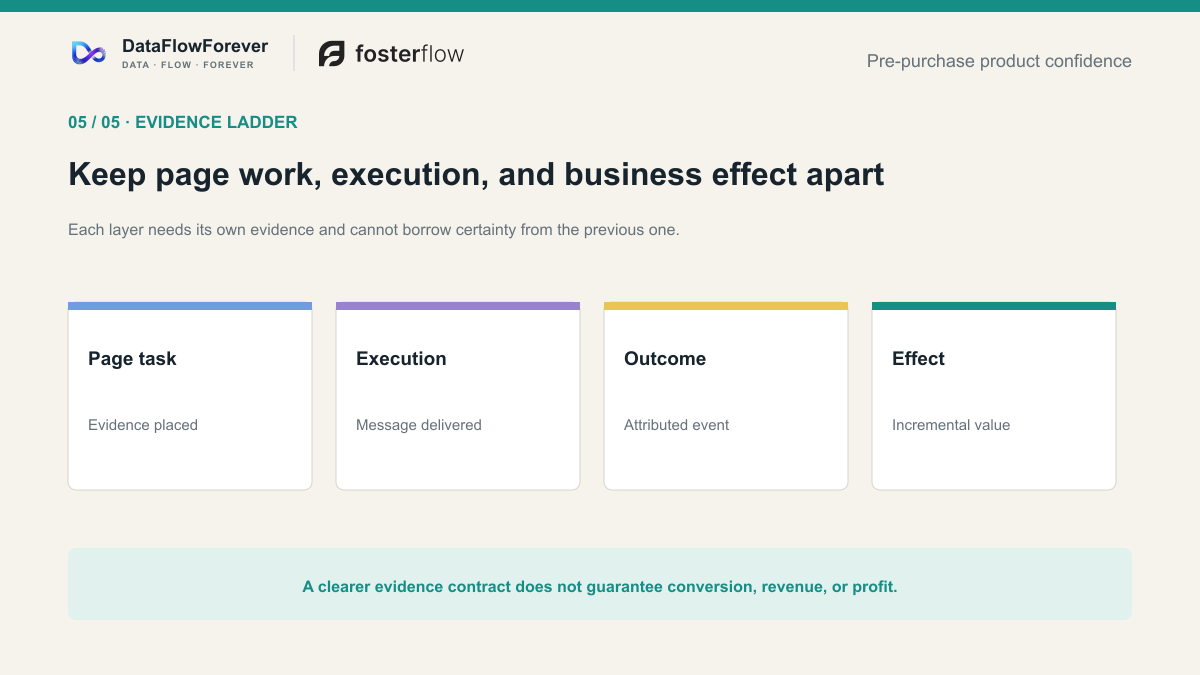
Separate four layers of observation:
- Workflow execution: Was the profile eligible, rechecked, approved, sent, skipped, or suppressed according to the contract?
- Customer task: Could the person reach the selected guide, identify a compatible model, interpret a measurement, inspect test conditions, or obtain a human answer?
- Attributed business outcome: Did a declared downstream event occur within the platform’s selected attribution window?
- Incremental and economic effect: Did the workflow cause additional useful outcomes compared with a credible counterfactual, after relevant costs, returns, timing, and contamination?
These are not interchangeable. A route click does not prove the original objection. Attributed revenue does not prove incrementality. Incremental orders do not necessarily establish profit. For an early test, use one product family, one message job, a documented observation window, and a comparison design appropriate to the decision. If identity coverage, sample, or contamination prevents a conclusion, report that limitation.
A synthetic example: the multi-generation charging dock
Consider a completely fictional Shopify store selling an unbranded desktop charging dock. The product name is shared across three device generations. Generation A is directly compatible, Generation B requires a small adapter, and Generation C has not been verified. A logged-in, email-eligible profile views the dock twice and has no connected purchase in the workflow window.
The workflow records only those facts. It does not label the shopper “compatibility anxious.” At send time, it checks consent, frequency, purchase state, current variant availability, price, and the compatibility record’s version date. The record is current, but the customer’s device generation is not known.
The proposed message has one job: help the recipient find the applicable compatibility state. Its neutral prompt is: “Want to check what this dock requires?” The choices are “Generation A,” “Generation B,” “Generation C,” and “I’m not sure.”
The routes behave differently:
- Generation A opens the current record and identifies direct compatibility under its listed conditions.
- Generation B explains that the named adapter is required, shows whether that adapter is included, and rechecks its stock state before displaying any availability statement.
- Generation C says that compatibility has not been verified and offers a staffed confirmation path. It does not infer compatibility from a similar connector.
- “I’m not sure” opens a model-identification guide without attaching a guessed device generation to the profile.
Before launch, the merchandising owner approves the product mapping, operations approves the adapter availability logic, support approves the response route, and the lifecycle owner approves identity, consent, exclusions, and copy. If the compatibility source expires, the adapter becomes unavailable, or no staffed confirmation path exists, the affected route is suppressed until a human approves a new state.
The first evaluation asks whether eligible customers could reach and interpret the correct route, whether unknown requests received a bounded response, and whether the workflow suppressed stale states correctly. Purchase outcomes may be observed separately. No route click is treated as proof of the original reason for browsing, and no platform-attributed order is automatically presented as a causal lift.
The example is synthetic. It represents no merchant, account, customer, product ID, result, or current FosterFlow deployment. The reusable part is the sequence: observe, gate, recheck, offer a neutral choice, route evidence or unknowns, obtain human approval, and measure the declared task.
How a Shopify team can start
A team can design this workflow around the segmentation, automation, recommendation, and analytics capabilities available in its Shopify stack. If FosterFlow is being considered, the exact events, identity links, consent states, product fields, recheck timing, approval controls, and measurement coverage still need implementation verification. A canvas or segment builder cannot supply a missing fact.
Start with one product family that generates a real decision task. Use an authorized internal sample or a fully synthetic example during design. Write a signal contract containing the observed event, identity and consent gate, product-state source, one message job, customer choices, unknown route, approvers, exclusions, freshness rule, stop conditions, and measurement layers.
Then test the contract before writing polished copy. The review may conclude that the product page needs a clearer model table, the shipping estimate lacks a reliable source, the support route has no owner, or the repeat-view signal is too noisy. Fixing the source—or making no change—can be the correct result.
Behavior is not intent. The responsible use of a lifecycle signal is not to sound as if the merchant read a shopper’s mind. It is to offer an eligible person a current, inspectable answer, preserve uncertainty when the answer is not known, and let a human remain accountable for every promise the workflow carries.