
Shopify Cart Recovery: What to Check Before Another Email
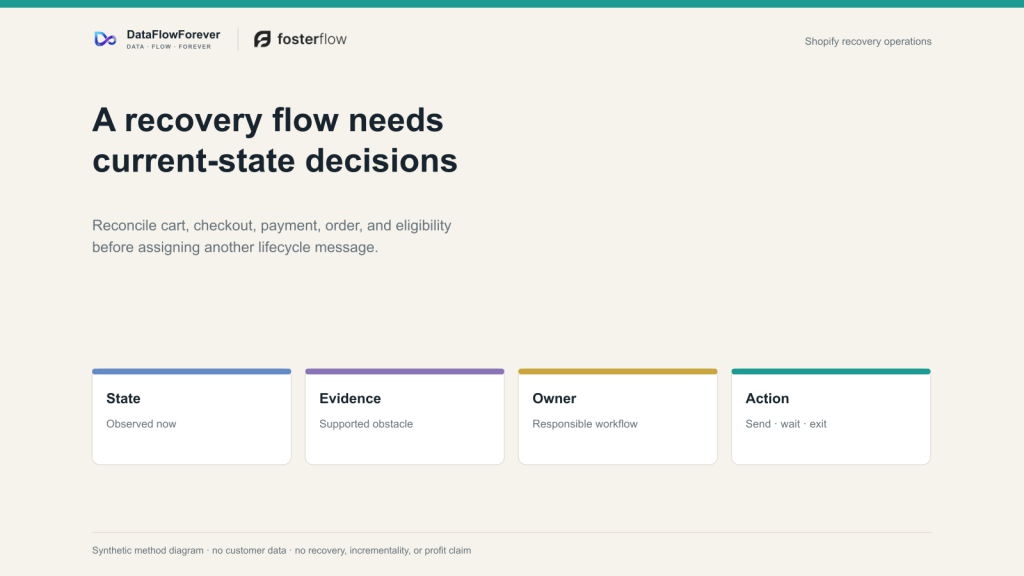
Consider a hypothetical Shopify merchant. The operator opens the Flow report and sees that the cart sequence ran as designed. Messages were delivered. Clicks may have occurred. The expected order is still absent.
At that moment, another email is a tempting fix. The team can change the subject line, move the delay, add urgency, or increase the offer. None of those changes explains what happened at checkout. The shopper may have completed a purchase through a different path, met an unsupported shipping destination, seen a total they did not expect, received a payment decline, removed the item, or decided that the purchase could wait.
A cart or checkout event can start a recovery review. It does not reveal the reason for leaving. Before each message, the Flow should refresh the shopper's current contact eligibility and the commerce facts that make recovery valid. It then chooses among send, wait, exit, and handoff.
This article shows how to design that decision. The narrower guide to stopping abandoned-cart emails after a Shopify customer purchases owns purchase precedence and exit testing. Here, the job is broader: determine which obstacle remains, whether messaging can help, who owns the repair, and how to review the result without confusing attributed revenue with incremental profit.
Define the shopping episode before interpreting the Flow
The first task is to define the episode being recovered. A lifetime profile can contain old carts, several devices, guest and signed-in sessions, multiple checkouts, completed orders, cancellations, and later purchases. A simple “has purchased” field can suppress legitimate repeat buying, while an unbounded “has not purchased” rule can keep an old episode alive.
For the current episode, specify:
- the cart or checkout identifier available to the implementation;
- the product and variant context retained with the event;
- the identity rules that connect browser, email, customer, checkout, payment, and order records;
- the event-time and processing-time boundaries;
- the purchase or terminal event that closes recovery; and
- the conditions under which ambiguous records wait for another check.
Google Analytics' Purchase Journey report gives a useful observable sequence: session start, item view, add to cart, begin checkout, and purchase. It also distinguishes closed and open funnels. That report can show where recorded progression stops. It cannot tell a Shopify team that shipping, price, product confidence, or payment caused the stop.
The underlying implementation deserves its own check. Google's GA4 ecommerce guide documents event and parameter structures for checkout, purchase, refund, items, value, and currency, together with debugging guidance. Seeing an event in a report is only the beginning. Confirm that item identity, amounts, currency, order identity, refunds, and duplicate handling correspond to Shopify's business records before the Flow or analysis relies on them.
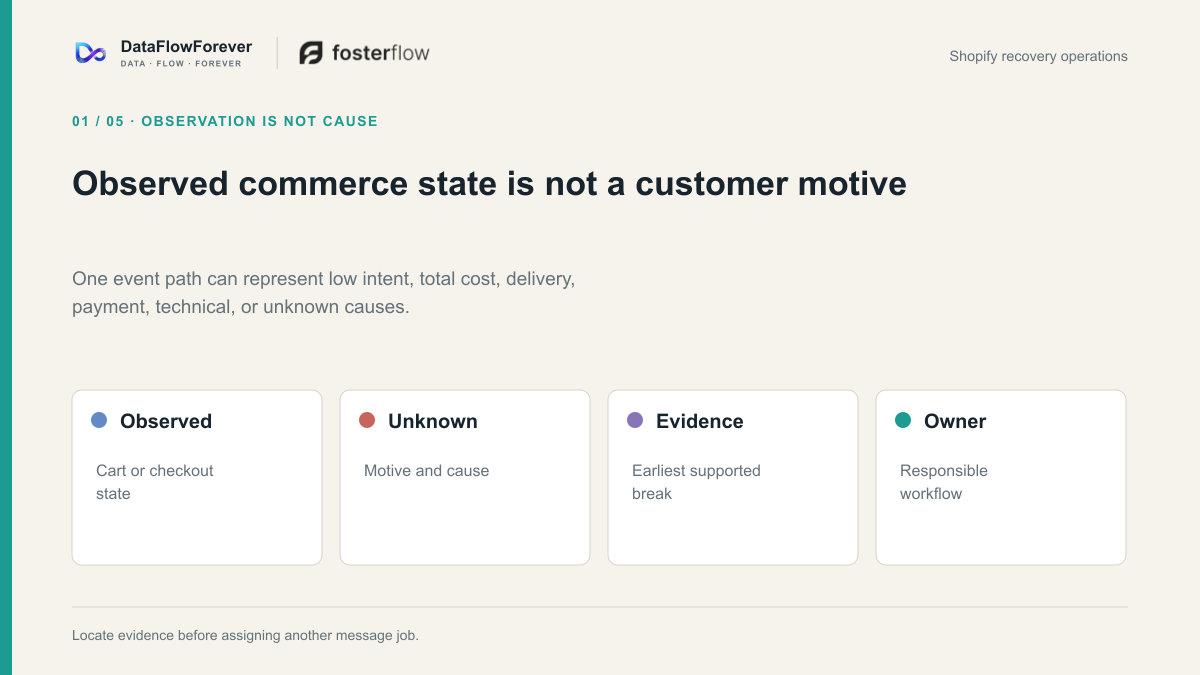
Research also gives a reason to keep intent open. The study “The Determinants of Consumers' Online Shopping Cart Abandonment” considered carts used for research, organization, and entertainment, alongside purchase inhibitors. It came from a particular research period and design. It cannot provide today's reason mix for a Shopify store or diagnose an individual shopper. It supports one useful Flow state: “intent unknown.”
Turn “abandoned” into obstacle classes the store can act on
A single abandoned-cart segment can contain cases that require opposite actions. The following classes keep the difference visible.
| Obstacle class | Evidence to inspect | Typical owner | Suitable Flow response |
|---|---|---|---|
| Intent unknown | Only observed cart or checkout behavior; optional customer choice | Lifecycle team | Offer a current path back or a neutral choice; avoid claiming motive |
| Product, fit, offer, or trust | Variant facts, size or compatibility evidence, return terms, offer eligibility | Merchandising, content, commercial owner | Link the exact answer or hand off the unresolved question |
| Total cost, shipping, tax, or delivery | Destination, rates, fees, serviceability, inventory location, delivery inputs | Fulfillment and commercial owners | Explain verified current conditions; do not promise unavailable service |
| Payment, authentication, or order | Provider state, authentication, payment method, order creation, support record | Payment and support operations | Give the supported next action or pause when records conflict |
| Technical or event integrity | Page errors, promotion conflicts, gateway return, event gaps or duplicates | Ecommerce engineering or data owner | Stop generic recovery and route the defect |
| Permission, reachability, or pressure | Consent, suppression, deliverability, quiet period, cross-channel contacts | Lifecycle team | Wait or exit when contact is not currently valid |
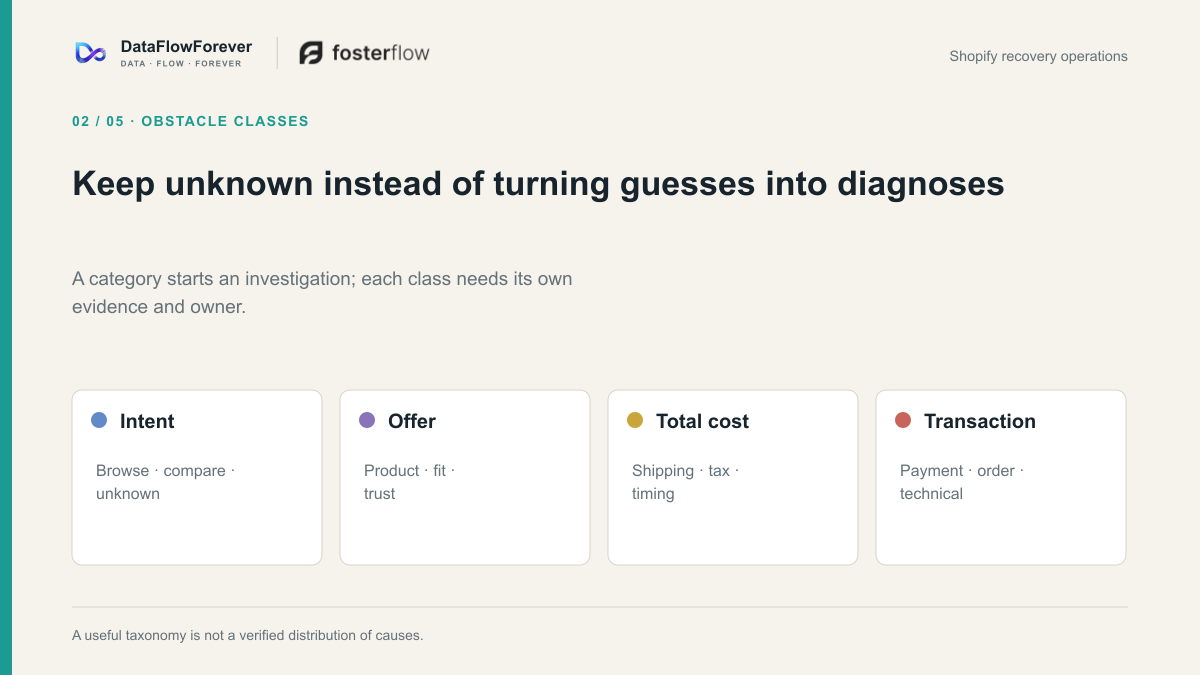
Shopify's abandoned-checkout recovery documentation illustrates why these classes belong together. The official page covers payment events and possible failures involving inventory, discounts, unsupported shipping, and returns from third-party gateways. It also describes conditions affecting recovery emails and notes the Shopify experience to which the page applies. Use those records to investigate a Shopify checkout; do not turn the page into a platform-independent promise.
Anonymous merchant and customer conversations can sharpen the vocabulary. Public threads ask why checkouts do not become sales and how to log checkout errors reported by shoppers. Other users describe repeated cart reminders as unwanted. These discussions are VOC, not statistical evidence, provider diagnosis, or a universal cadence recommendation.
Refresh the facts when the message is due
Flow entry answers a historical question: did this profile meet the entry rule at that time? A later action needs a new answer. The current cart, offer, inventory, permission, payment, and order may differ from the entry snapshot.
Place a decision check before every consequential message:
Contact eligibility
Confirm the identity connection used for this episode, current channel permission, reachability, unsubscribes, suppressions, complaint state, applicable quiet period, and commercial contact from other campaigns or channels. A profile that was reachable at entry may be ineligible now.
For US commercial email, the FTC's CAN-SPAM guide for businesses explains message-purpose classification, opt-out mechanisms and handling, and the sender's responsibility when another company sends on its behalf. That is a US scope, not global consent or privacy advice. It supports an implementation requirement: current opt-out and suppression state must be able to stop the action.
Cart, merchandise, and offer
Check whether the cart still contains the relevant item, the variant is sellable, inventory and price are current, and any offer remains eligible. An empty cart, removed item, unavailable variant, or invalid offer may close the current message job. If the offer rule is failing, route it to the commercial or ecommerce owner instead of compensating with a different generic coupon.
Shipping and delivery
Recalculate destination eligibility, shipping cost, required charges, and delivery range from current inputs. Do not reuse a stale promise from the first message. The FTC's US Mail, Internet, or Telephone Order Merchandise Rule guide describes the need for a reasonable basis for shipping representations and duties involving delay, cancellation, and refund within its scope. It does not predict conversion or apply globally. Once an order exists, the journey belongs in fulfillment or the applicable delay, cancellation, and refund path.
Payment and order
Compare the latest payment attempt with the order record. Determine whether customer authentication, corrected information, another method, a later retry, issuer contact, or a stop is supported. If payment appears successful in one system and no order appears in another, wait and route the inconsistency. A generic cart reminder is a poor substitute for order-state investigation.
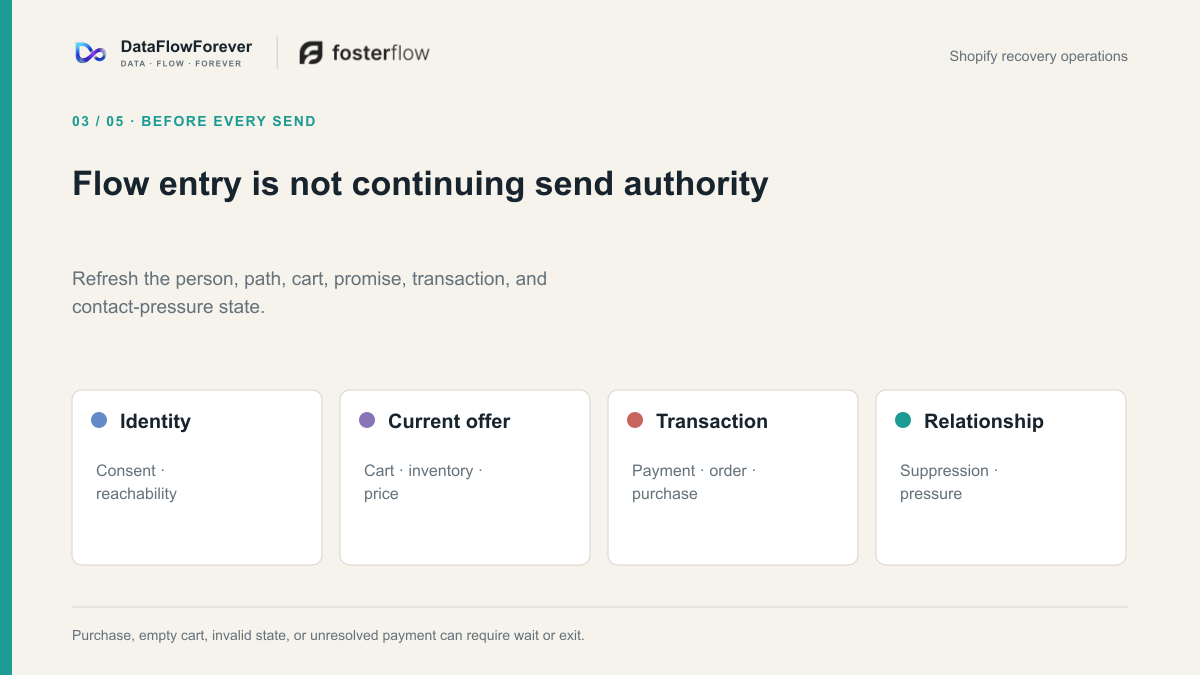
The resulting action can be explicit:
- Send when current eligibility and commerce facts support one useful message job.
- Wait when an authoritative state is still processing or a quiet-period rule applies.
- Exit when purchase, cart removal, unavailable merchandise, unsupported service, invalid contact eligibility, or another terminal condition ends recovery.
- Hand off when payment, checkout, fulfillment, product, or support work is required outside messaging.
Exact Shopify events, payment-provider fields, identity behavior, historical coverage, and Flow controls vary by implementation. Verify them against the current store and connected systems. A diagram or configured draft proves design intent; it does not prove that every runtime decision, delivery, or outcome occurred.
Translate payment codes into supported customer actions
Payment branches need more precision than “try again.” Stripe's decline-code documentation maps different codes to actions such as authentication, correcting information, choosing another method, trying later, contacting the issuer, or stopping further attempts. The mapping is specific to Stripe's interface; stores using another provider need that provider's current documentation.
do_not_honor deserves special care. Stripe describes it as an issuer decline for an unknown reason and advises the customer to contact the issuer for more information. Where the checkout supports it, another payment method can be offered. The code does not establish insufficient funds, fraud, a lost or stolen card, merchant fault, Shopify fault, or Stripe fault.
An anonymous public post asks about Shopify payment failures showing DO NOT HONOR. The post is useful because it exposes the operator's uncertainty and the need for clear help content. It cannot identify the underlying cause. Keep the customer copy neutral, preserve sensitive issuer reasons, and base the next step on provider and order records.
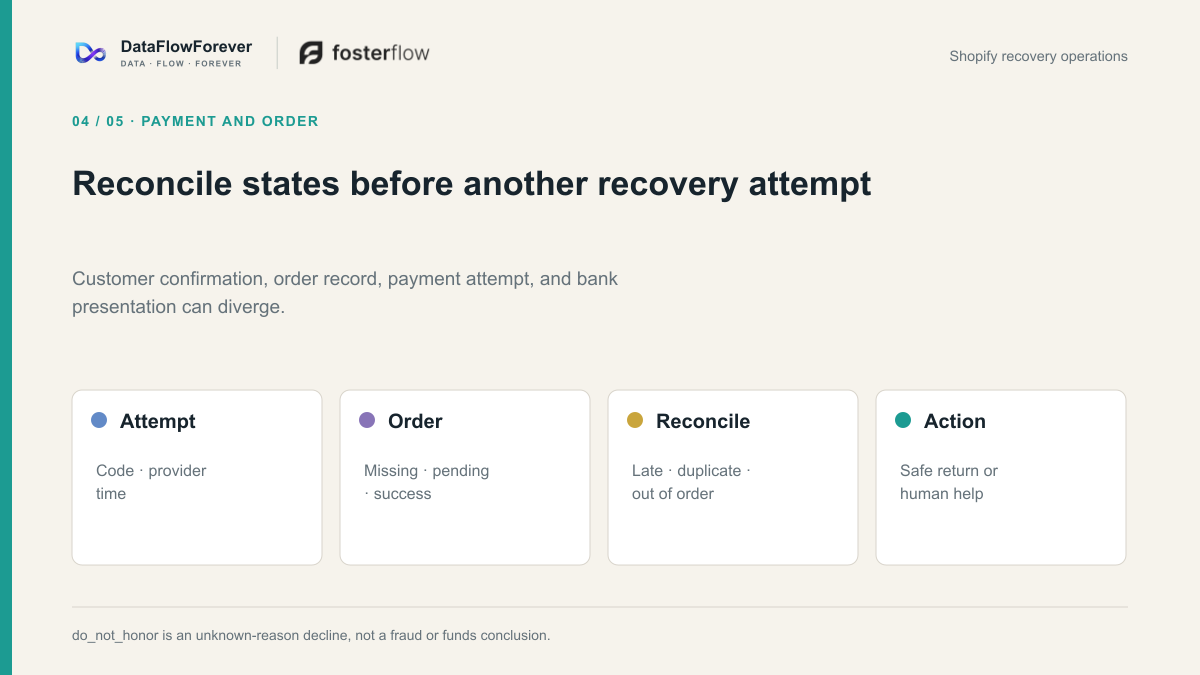
Before the payment-help message runs, repeat the purchase and order check. A customer who already completed the order should leave recovery. A customer whose records are inconsistent should be routed to support. Only a current unresolved state with a supported customer action should receive payment guidance.
Design the sequence around changing jobs
A sequence earns its later messages by helping with a different task or using new evidence. A Shopify recovery plan may include these jobs without assuming that every store needs all of them:
- restore access to a still-valid cart;
- make current total cost and delivery conditions easy to inspect;
- provide a verified product, fit, return, or service answer;
- help complete payment authentication or select an available method;
- invite an optional reason selection;
- close the path when the item, offer, contact eligibility, or episode is no longer valid.
Repeating the cart contents with a new subject line leaves the job unchanged. Discounts should have their own eligibility, cost, and review. They can affect contribution, later buying expectations, and which shoppers respond. No research source in this review supports a universal discount, free-shipping threshold, delay, or three-email sequence.
The longitudinal study “Enough Is Enough!” examined customer communication volume, channel combinations, preference alignment, and repurchase response across an existing-customer setting. It is not a Shopify abandonment experiment and cannot supply a fixed frequency. It supports looking at total contact pressure across channels and testing preference-aware limits.
That distinction also reflects anonymous VOC. Marketers discuss whether to use a three-step abandoned-cart sequence, while consumers describe the discomfort of being contacted because an item remained in a cart. Their accounts are prompts for review, not evidence that a particular number is right.
Add a Recovery Decision Record to every node
The Recovery Decision Record captures why the Flow selected send, wait, exit, or handoff. It gives lifecycle, ecommerce, payment, and support owners one reviewable unit.
| Record field | Implementation question |
|---|---|
| Episode and evidence time | Which current shopping episode and evidence version does this decision cover? |
| Observed commerce state | What do cart, checkout, payment, order, purchase, cancellation, and refund records currently show? |
| Contact eligibility | Which identity, consent, reachability, suppression, quiet-period, and contact-pressure facts apply? |
| Obstacle hypotheses | Which classes remain possible, and which one has enough evidence to act on? |
| Unknowns and conflicts | Which required fact is missing or disagrees across systems? |
| Owner and action | Who can resolve the condition, and is the Flow sending, waiting, exiting, or handing off? |
| Message job | What one task will the shopper be able to complete after receiving this message? |
| Recheck and measurement | Which change triggers another decision, and which commerce and cost facts will be reviewed? |
The record can be implemented with the store's available customer, event, order, Flow, support, and reporting tools. Avoid claiming recipient-level decision auditing or arbitrary event properties until the exact current product and integration support has been verified. Where a field is unavailable, preserve “unknown” and define the manual or system handoff required to resolve it.
Consider a fully synthetic example. It uses no merchant, customer, product, account, order, or result data.
A fictional profile begins checkout for an in-stock item. The current price and destination are supported. The next payment attempt returns do_not_honor, and no confirmed order is visible in the connected record. The profile remains eligible for email, but a generic reminder has already been delivered. The decision class is payment/order, the issuer reason stays unknown, and the owner is payment support. The permitted message explains two supported paths: use another available method or contact the issuer. A new order event exits the episode. Conflicting payment and order records wait and hand off. Lack of a later purchase does not become a reason to increase the discount.
Collect reasons without turning responses into ground truth
An optional, short question can reveal customer language: “saving for later,” “delivery does not work,” “total is too high,” “payment failed,” “product question,” or “other.” Keep the selection voluntary and avoid writing the answer back as a permanent psychological profile.
Respondents are self-selected. An incentive may also change participation. The review “The Use and Effects of Incentives in Surveys” covers response, quality, nonresponse error, cost, and web surveys. It does not study abandoned Shopify shoppers, and a larger response count does not automatically improve representativeness.
Use responses as hypotheses and compare them with relevant records. A shipping response can be checked against destination, rate calculation, and delivery exits. A payment response can be compared with provider and order state. A promotion response can be checked against eligibility and error logs. No response remains “no response.”
Total-price presentation can also be isolated experimentally. “Price Salience and Product Choice” reports a randomized StubHub field experiment comparing mandatory-fee disclosure timing and examining purchase, product choice, and spending. It does not endorse hidden fees, and its effect sizes should not be applied to a Shopify store. It demonstrates why fee presentation deserves its own intervention rather than being mixed into an email-copy test.
Review recovery from eligibility through contribution
Shopify can mark a checkout as recovered after a recovery-link visit or through another path described in its documentation. That status is helpful for operations. It is an attribution label, not automatic evidence of causation or profit.
Review the workflow in layers:
- Eligible recovery population: current identity, permission, reachability, and valid episode.
- Decision behavior: sends, waits, exits, and handoffs by reason and node.
- Message and customer action: delivery, return to checkout, payment authentication, support request, or no observed next action.
- Commerce facts: payment, order, cancellation, refund, and return connected under the declared scope.
- Economics: discount, shipping subsidy, payment fees, product cost, refunds, and returns where the required data is available.
- Incrementality: an appropriate control or staged design that separates recovery from natural completion, another channel, and concurrent storefront changes.
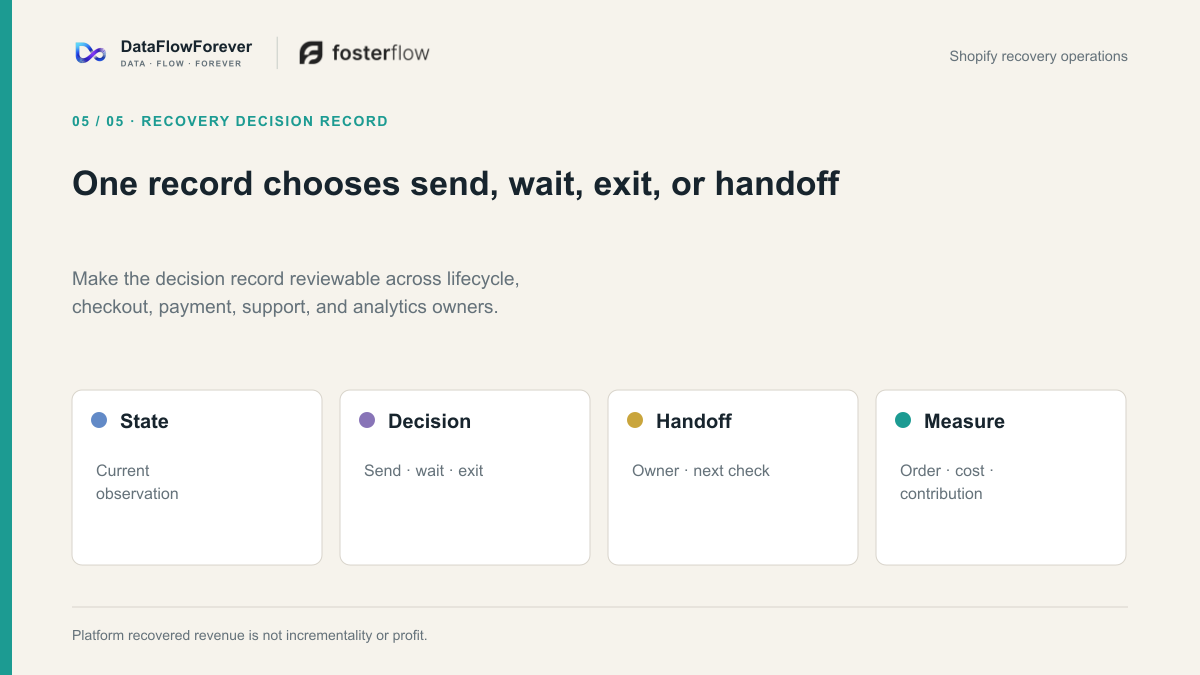
Change one repair at a time. Shipping transparency, checkout defects, payment guidance, message job, and incentive policy have different owners and hypotheses. A combined launch may change orders, but it will not explain which repair earned the change.
Build the smallest useful recovery audit
Start with one active Shopify cart or checkout Flow. For each message node, document the entry episode, current-state refresh, allowed action, obstacle owner, message job, stop condition, and result scope. Use a small, reviewable set of safely handled records or test profiles, including purchase before send, stale cart, unavailable item, unsupported destination, payment requiring customer action, delayed order state, opt-out, and contact-pressure conflict.
FosterFlow supports Shopify-focused email automation, Flow design, segmentation, and analytics. The Recovery Decision Record gives those capabilities a disciplined operating job. Exact event coverage, payment detail, identity matching, field availability, runtime checks, and reporting must be confirmed for the intended store and integration; the method does not turn missing evidence into a product claim.
If a sequence has already sent three messages without resolving the obstacle, the next useful step is an audit of one node. Map what the Flow knew, what changed before dispatch, who owned the unresolved condition, and what evidence would justify the next action. Then keep, revise, pause, or remove the message based on that record.