
Welcome Email Series: A 5-Step Sequence That Converts
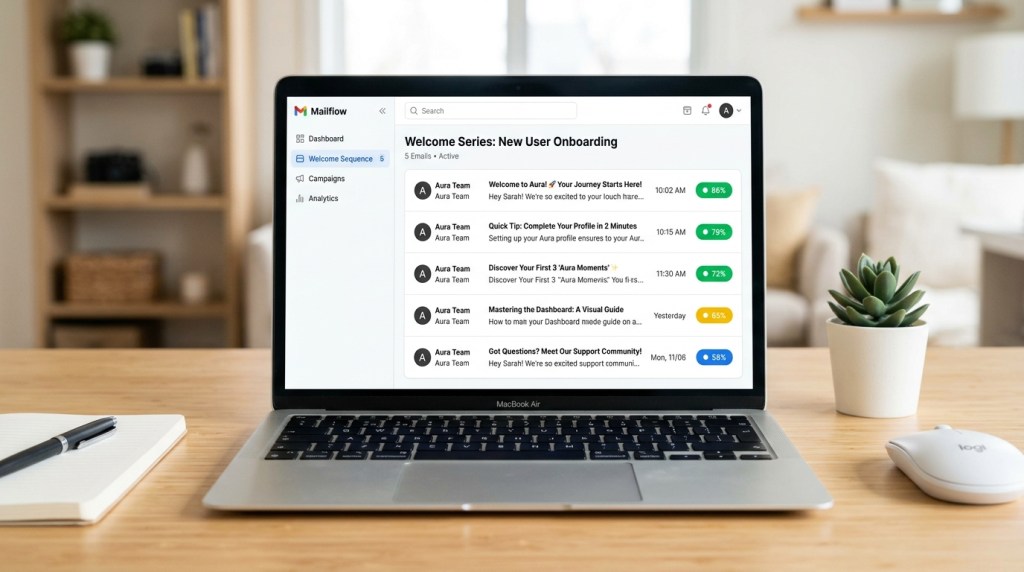
The first email you send a new subscriber is the most important email you’ll ever send them.
Not your Black Friday campaign. Not your restock announcement. Not even your best-performing product launch. The welcome email.
Here’s why: when someone joins your list, they’re at peak curiosity about your brand. They opted in — which means they explicitly said “yes, I want to hear from you.” Open rates for welcome emails routinely hit 50–60%, compared to 20–25% for regular campaigns. That’s two to three times more people reading your message.
The problem is that most Shopify stores squander this window with a single, generic “Thanks for signing up!” email and a discount code. No brand story. No product education. No follow-through.
A proper welcome email series — a sequenced set of emails spread over 7–10 days — can generate 3x more revenue than a single welcome email. For stores that build it properly, the welcome series becomes their highest-revenue automation, often surpassing even the abandoned cart flow.
This guide walks you through a 5-step sequence that moves new subscribers from curious to converted, and the personalization tactics that make each step land harder.
Why a Welcome Series Outperforms a Single Welcome Email
The case for a multi-email welcome sequence comes down to one thing: buying decisions take time.
A new subscriber typically needs multiple touchpoints before making a first purchase. They need to:
1. Understand what you sell and why it’s worth their attention
2. Trust that your products deliver on your claims
3. Have a reason to buy now rather than later
A single welcome email can deliver #3 (the discount) but rarely has enough space to address #1 and #2 well. A series gives you the room to build genuine desire before making the ask.
Research from Omnisend found that welcome series with 3+ emails generate 90% more orders than single welcome emails. The incremental lift from each additional email drops after email 3–4, which is why 5 is the sweet spot — enough to build the relationship without overstaying your welcome.
The 5-Step Welcome Series Structure
Here’s the exact sequence, what each email achieves, and when to send it.
Email 1: Welcome + Deliver the Offer (Send Immediately)
Goal: Set expectations, deliver what you promised, make a strong first impression.
This email fires the moment someone joins your list. If you offered a discount, a freebie, or a lead magnet at signup, this is where you deliver it — immediately, without making them hunt for it.
What to include:
- Subject line: Deliver the promise directly. “Your 15% off code is inside” beats “Welcome to [Brand Name]” every time when there’s an incentive. If there’s no incentive, lead with personality: “You’re in. Here’s what happens next.”
- The incentive: Clear, prominent, easy to use. Don’t bury the discount code in paragraph 4.
- A brief brand statement: One or two sentences on who you are and what you’re about. Not your founding story (that’s Email 2) — just the core premise. “We make [product] for [audience] who care about [value].”
- What’s coming: Set expectations for the series. “Over the next few days, we’ll share [what to expect].” This primes subscribers to look for your next email.
- One clear CTA: Shop now, or use your code. Don’t clutter with multiple links.
Personalization tip: If you collected any data at signup (gender, category preference, what they’re shopping for), use it. “Welcome, and since you mentioned you’re shopping for [X], here’s where to start” is a powerful opening line.
Email 2: Brand Story (Send Day 2–3)
Goal: Create an emotional connection and differentiate your brand from every other store selling similar products.
Most people buy from brands they believe in, not just products they want. This email is your chance to tell the story that makes you worth caring about.
What to include:
- Why you started: The founding story doesn’t need to be dramatic, but it needs to be genuine. What problem were you trying to solve? What frustrated you about the existing options?
- What makes you different: This is not a feature list. It’s a values statement. Do you source sustainably? Are you a family business? Do you donate a portion of profits? Do you make products that outlast the competition?
- The people behind the brand: A photo of the founder, the team, or the production process humanizes the brand enormously. Stores that include a real photo of a real person in Email 2 see meaningfully higher click-through rates.
- A soft product mention: You’re not selling hard in this email, but you can point to a collection or a flagship product as an expression of your values.
What NOT to do: Don’t make this a sales email. If Email 2 is clearly trying to push a purchase, subscribers feel like the brand story was just a manipulation tactic. The goal is genuine connection. Trust that the connection will pay off in purchases.
Subject line formulas:
- “Here’s why we started [Brand Name]”
- “The story behind [product/brand]”
- “Why we do things differently”
Email 3: Bestsellers + Product Education (Send Day 4–5)
Goal: Remove discovery friction and help new subscribers find the right products for them.
New subscribers often don’t know where to start. Your catalog might have hundreds of SKUs. Email 3 does the work of curation — pointing them to your most loved, most purchased, most talked-about products.
What to include:
- Your top 3–5 products or collections, with strong photography and a brief description of who each one is for
- Social proof on the specific products: “Our #1 seller” or “4.9 stars from 1,200+ reviews” next to a product image is highly effective
- Framing by use case or outcome, not just product features: “For the runner who wants to go further” beats “Lightweight, breathable, moisture-wicking”
- A secondary reminder of the welcome offer if it hasn’t been used yet — subtle, at the bottom: “Reminder: your 15% off code [CODE] expires in [X] days.”
Personalization tip: If your email platform supports it, dynamically show different product recommendations based on what category the subscriber browsed before signing up. Someone who joined your list after looking at women’s shoes should see different “bestsellers” than someone who came in through your men’s accessories collection. FosterFlow’s behavioral segmentation enables this kind of dynamic content without manual list splitting.
Subject line formulas:
- “Our most-loved products (picked by 10,000+ customers)”
- “Not sure where to start? We’ve got you.”
- “These are our customers’ favorites”
Email 4: Social Proof + Community (Send Day 6–7)
Goal: Eliminate doubt with real customer evidence and create a sense of belonging.
By Day 6–7, a subscriber who hasn’t purchased yet is still considering. The most common barrier at this stage isn’t awareness or desire — it’s risk. “What if I don’t like it?” “What if it doesn’t work for me?”
Social proof is the most powerful tool for overcoming risk aversion. Not generic reviews — specific, detailed, relatable customer stories.
What to include:
- 3–5 detailed customer testimonials, ideally with photos, names, and specific outcomes (“I’ve tried 8 different [products] and nothing worked until this one”)
- User-generated content: Real photos of customers using your products convert better than professional photography because they’re authentic. If you have UGC on Instagram or in reviews, this is the email to showcase it.
- Numbers that signal scale: “Trusted by 50,000+ customers” or “4.8 average from 12,000 reviews” — the wisdom of crowds is genuinely persuasive
- A guarantee or risk-reversal statement: Returns policy, satisfaction guarantee, or money-back offer. State it clearly and prominently.
- Community references: If you have an active community — a Facebook group, a loyalty program, a community forum — mention it. Being part of something larger increases belonging and retention.
Subject line formulas:
- “Here’s what 12,000+ customers are saying”
- “Real customers, real results”
- “Don’t just take our word for it”
Email 5: Last Chance / Urgency (Send Day 9–10)
Goal: Convert the remaining undecided subscribers before the welcome offer expires.
This is the close. If a subscriber has been in your welcome series for 9–10 days and hasn’t purchased, they’re either not ready, not interested, or waiting for a push. Email 5 provides that push.
What to include:
- Clear, prominent urgency: The welcome offer expires in 24–48 hours. State this explicitly in the subject line, the headline, and the body. Don’t soften it.
- A recap of what they get: Briefly remind them of the offer and what the products deliver. Not a full re-education — just the highlights.
- Address the most common objection one last time: A single sentence on your returns policy or guarantee goes a long way when someone is right on the fence.
- Strong, single CTA: “Shop now and save” or “Use your code before it expires.” One action, one click.
What to do after Email 5: Subscribers who didn’t convert during the welcome series aren’t lost — they move into your regular list. Don’t suppress them. They may not have been ready to buy during the welcome window, but they may convert later from a campaign, a restock notification, or a sale announcement.
Subject line formulas:
- “Your 15% off expires in 24 hours”
- “Last chance — your welcome offer ends tonight”
- “This is your last reminder (we mean it)”
Timing Summary
| Email | Trigger | Goal |
|——-|———|——|
| Email 1 | Immediately on signup | Deliver offer, set tone |
| Email 2 | Day 2–3 | Build emotional connection |
| Email 3 | Day 4–5 | Drive product discovery |
| Email 4 | Day 6–7 | Social proof, eliminate risk |
| Email 5 | Day 9–10 | Urgency, final conversion |
The gaps between emails are deliberate. Sending daily feels like a pressure campaign. The 2-day spacing respects the subscriber’s inbox while maintaining momentum.
Personalization Tactics That Increase Conversions
A generic welcome series will outperform no welcome series. But personalization dramatically increases the gap.
Segment by signup source. A subscriber who joined via an exit-intent popup is in a different mindset than someone who signed up from a product page during a purchase. Use different subject lines and opening copy for each source.
Use browse history. If your new subscriber was browsing a specific category before signing up, reference it. FosterFlow’s Shopify Events API integration captures this behavior data and makes it available for flow personalization — no manual list management or CSV exports required.
Suppress converters. If a subscriber makes a purchase during the welcome series, they should exit the welcome flow and enter the post-purchase sequence instead. Sending “your offer expires soon” to someone who already bought creates a bad experience.
A/B test subject lines. The welcome series is the highest-volume, highest-open-rate automation you have. Small subject line improvements compound significantly at scale. Test one variable per email: format, sender name, or send time.
What Good Performance Looks Like
| Metric | Typical Range | Strong Performance |
|——–|————–|——————-|
| Email 1 Open Rate | 50–65% | 65%+ |
| Email 2 Open Rate | 35–50% | 50%+ |
| Email 3 Open Rate | 25–40% | 40%+ |
| Email 4 Open Rate | 20–35% | 35%+ |
| Email 5 Open Rate | 20–30% | 30%+ |
| Series Conversion Rate (first purchase) | 15–25% | 25%+ |
If your open rates drop sharply after Email 1, suspect: too-long gaps between sends, subject lines that don’t build curiosity, or content that feels generic rather than brand-specific.
If your series conversion rate is below 15%, look at Email 3 (product clarity) and Email 4 (social proof) — these are the most common weak links.
Build Your Welcome Series in FosterFlow
A 5-email welcome series might sound complex to set up, but with the right tool, it’s a few hours of work that runs for years.
FosterFlow offers a pre-built welcome series template with the recommended timing and logic already configured. You customize the copy and design, connect your Shopify product catalog for dynamic product blocks, and set your discount parameters. The purchase-suppression logic — ensuring buyers exit the flow and enter post-purchase instead — is built in automatically.
The result: a fully personalized, behavior-aware welcome series that converts new subscribers into first-time buyers, and first-time buyers into loyal customers.
Start your welcome series with FosterFlow — install from the Shopify App Store and have your first email live today.
Related reading: [9 Must-Have Email Automations for Every Shopify Store](#) | [How to Set Up Abandoned Cart Emails in Under 10 Minutes](#)