
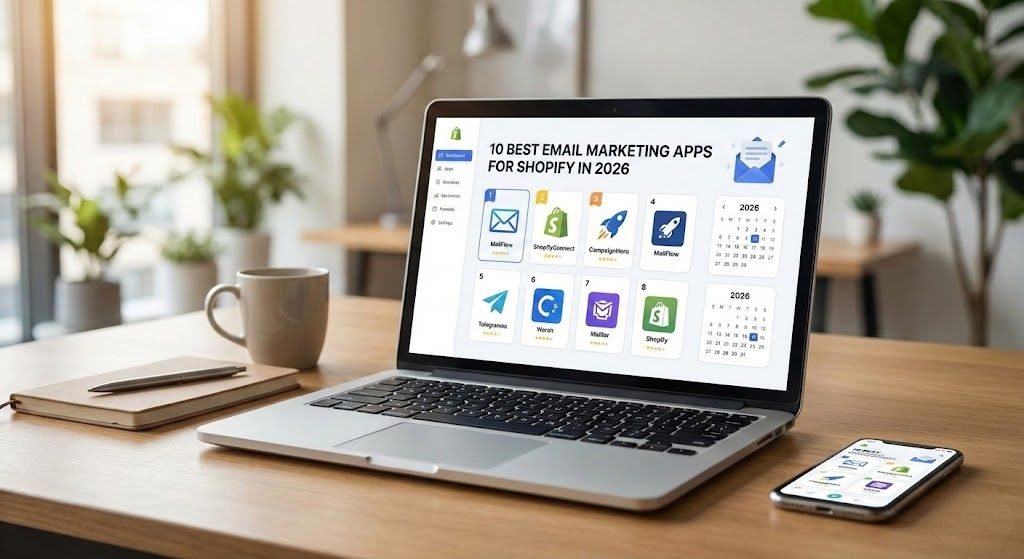
10 Best Email Marketing Apps for Shopify in 2026

What Repeat Product Views Can—and Cannot Tell Shopify Merchants Before Checkout

Email is still the most profitable marketing channel for ecommerce, and in 2026, it’s not even close. With rising ad costs, stricter privacy rules, and reduced tracking on platforms like Facebook and TikTok, Shopify brands need direct, owned communication more than ever, as ReportGenix notes in their analysis.
If you’ve been relying on social media ads alone, you already know the pain. One algorithm change can tank your reach overnight. But email? It’s predictable, cost-effective, and fully under your control—no algorithm surprises or ad platform meltdowns, according to OptiMonk’s digital marketing research.
For Shopify stores, email delivers a 42:1 return—meaning you get $42 back for every dollar spent. Despite all the talk about email being “dead,” it remains the workhorse of ecommerce marketing, as Brenton Way’s Shopify statistics confirm.
The problem? There are hundreds of apps in the Shopify App Store. Choosing the right one can feel overwhelming. That’s why we put together this guide to the best email marketing apps for Shopify—so you can spend less time comparing tools and more time growing your store.
What Makes a Great Shopify Email Marketing App?
Before diving into our picks, let’s talk about what actually matters when choosing an email app for your store.
Email Vendor Selection explains that the best Shopify email marketing apps have everything you need for successful email marketing: drag-and-drop editor with templates, automation, detailed analytics, customer segmentation, and painless integrations with Shopify.
Choose an app that connects smoothly with Shopify so it can automatically sync customer data, orders, and product details. This makes it much easier to send relevant, personalized emails—and Outfy reports that 76% of consumers say personalized messages are essential in helping them consider a brand.
You also want pre-built workflow templates for things like abandoned cart recovery flows, welcome series, and post-purchase upsells. These small touches make a big difference in conversion rates. And with 49% of marketers now using generative AI for email copy creation, according to InboxAlly’s research, AI-powered optimization is quickly becoming table stakes.
1. FosterFlow – Best for Shopify-Native Automation
We built FosterFlow specifically for Shopify merchants who want to stop “sending emails” and start building a growth machine. Our platform connects directly to your store in seconds, unlocking real-time customer data, automated marketing flows, and dynamic product recommendations—all without manual syncing.
What sets FosterFlow apart is our two-way Shopify integration. We leverage the full Shopify Events API to cover all transactional and behavioral triggers—from order creation to wishlist activity. You can use FosterFlow events as triggers in Shopify Flow, and our actions work directly within your existing Shopify workflows.
Our AI-powered optimization uses your Shopify data to achieve hyper-personalized flows and campaigns. The drag-and-drop builder automatically syncs your store’s brand colors and fonts, pulling assets directly from Shopify Files so every email looks pixel-perfect.
FosterFlow pricing starts at $9/month for 5,000 emails—making it accessible for stores of all sizes.
2. Klaviyo – Best for Data-Driven Stores
Klaviyo is one of the most popular email tools for Shopify—and it shows. Encharge’s comparison notes that it syncs instantly and pulls in everything: customer tags, order data, viewed products, checkout activity, you name it. It’s packed with options.
Smart Send Time delivers emails when subscribers are most likely to buy, while predictive analytics identify churn risks before they leave. ReportGenix found that stores see 29% more email revenue within 90 days and 41% better cart recovery with Klaviyo.
The downside? Encharge also points out that the interface can feel overwhelming at first. It’s made for power users, so if you’re not already comfortable with email marketing, it might take a while to get the hang of everything.
3. Omnisend – Best for SMS and Email Synergy
Omnisend excels by unifying email, SMS, and push notifications in one platform. ReportGenix’s analysis shows that customers receiving omnichannel messages spend 13% more than single-channel recipients, making this integration invaluable.
The pre-built workflows are exceptional—welcome series, cart recovery, and order follow-ups work instantly but remain customizable. Their Wheel of Fortune popups and gamification tools capture 30% more emails than standard forms, as ReportGenix documents.
It’s beginner-friendly. Outfy highlights that the drag-and-drop builder makes it easy to design professional emails, even if you’ve never done it before. And if you’re ready to get more advanced, you’ll find plenty of automation workflows you can set up without hassle.
4. Shopify Email – Best Free Option for Beginners
Since its launch in 2019, Shopify Email has made significant improvements. Email Tool Tester reports that Shopify Email now boasts powerful customization and automation features included for free with your Shopify plan.
The Shopify Email app is free to install with all subscription plans. Email Tool Tester confirms that it allows you to send 10,000 emails each month for free, then it’s $1 USD for every 1,000 emails you send.
However, ReportGenix warns that it quickly becomes limiting for growing stores. The basic automation and minimal segmentation mean you’re leaving money on the table if you’re serious about lifecycle marketing campaigns.
5. Privy – Best for Pop-Up Forms and List Building
AITrillion describes Privy as a powerful email marketing software for Shopify that helps you build your list and convert visitors with ease. It combines popups, email, and SMS into one of the most effective paid Shopify email tools available.
This app is ideal for creating high-impact Shopify email campaigns without needing a developer. AITrillion explains that with drag-and-drop editing, customizable templates, and Shopify integration, Privy makes it easy to launch beautiful, targeted campaigns in minutes.
If your main goal is growing your subscriber list quickly, Privy’s pop-up form builders and lead generation tools are hard to beat.
6. Active Campaign – Best Automation Builder
Email Vendor Selection reports that ActiveCampaign is a Shopify email marketing app with one of the best automation builders. You can easily connect it with your Shopify store to send automated emails based on purchase history. It also has an advanced automation builder with 900+ automation templates.
This includes 39 pre-made templates for Shopify workflows for upsell, cross-sell, cart abandonment, and promotions. Plus 80+ ways to segment customers, like total earnings, last purchase date, shipping method, discount code, and cart abandonment, according to Email Vendor Selection.
The learning curve is steeper, and it’s pricey for simple newsletters. But for stores that want granular behavioral targeting and complex customer segmentation logic, it delivers.
7. Seguno – Best Budget-Friendly Shopify App
Outfy notes that Seguno is a Shopify-focused email marketing app that’s perfect for small to medium stores. Its biggest advantage is how well it integrates with Shopify—everything from your products to customer data syncs automatically.
With Seguno, you can create automated workflows like welcome emails, abandoned cart reminders, and post-purchase follow-ups. Outfy adds that the drag-and-drop editor is simple, making it easy to design emails even if you don’t have design experience. Many Shopify store owners love Seguno because it’s affordable and doesn’t overcomplicate things.
One brand boosted conversion rates on sample orders by 30% with Seguno Email Marketing, as featured in the Shopify App Store.
8. Mailerlite – Best for Simple Newsletter Builders
Email Vendor Selection describes MailerLite as an easy-to-use email marketing software for Shopify. It has a Shopify app to sync customer data, purchase history, and subscription information. You can easily add products to your emails and segment contacts based on Shopify data.
MailerLite has a free plan with 12K emails, 500 subscribers, A/B testing, automation, landing pages, sign-up forms, and pop-ups, as Email Vendor Selection details. If you’re just starting out and want a straightforward drag-and-drop newsletter builder without overwhelming features, this one’s worth testing.
9. Drip – Best for Advanced Personalization
Drip positions itself as a “revenue attribution” platform, focusing heavily on showing you exactly which emails drive sales. It’s particularly strong for direct-to-consumer communication and RFM analysis (recency, frequency, monetary value).
The visual workflow builder makes it easy to create behavior-based automations, though the pricing scales quickly as your list grows. Best for stores already comfortable with email who want to take personalization to the next level.
10. Brevo (formerly Sendinblue) – Best CRM + Email Combo
Email Vendor Selection calls Brevo the best SMS, email marketing, and CRM combo for Shopify. If you need a lightweight CRM alongside your email marketing—think: tracking customer lifetime value, managing sales pipelines, and sending transactional emails—Brevo bundles everything together.
The free plan is generous for small stores, and the transactional email feature is handy for order confirmations and shipping notices that need to land in inboxes reliably.
Quick Comparison: Best Email Marketing Apps for Shopify
| App | Best For | Starting Price | Free Plan? |
|---|---|---|---|
| FosterFlow | Shopify-native automation | $9/mo | Yes |
| Klaviyo | Data-driven personalization | $20/mo | Yes (limited) |
| Omnisend | Email + SMS synergy | $16/mo | Yes |
| Shopify Email | Beginners | $0 | Yes (10K emails) |
| Privy | List building | $24/mo | Yes |
| ActiveCampaign | Complex automation | $29/mo | No |
| Seguno | Budget-conscious stores | $10/mo | Yes |
| MailerLite | Simple newsletters | $9/mo | Yes |
| Drip | Revenue tracking | $39/mo | No |
| Brevo | CRM + email | $25/mo | Yes |
How to Choose the Right App for Your Store
With 96.8% of top Shopify stores actively collecting emails, according to OptiMonk’s research, this isn’t just best practice—it’s survival. But the “best” app depends entirely on your situation.
If you’re just starting out: Shopify Email or Seguno give you the basics without overwhelming complexity.
If you want deep Shopify integration: FosterFlow or Klaviyo offer real-time data synchronization and full Events API coverage.
If you need omnichannel marketing: Omnisend or Privy combine email, SMS, and pop-ups in one dashboard.
If automation is your priority: ActiveCampaign’s 900+ workflow templates or FosterFlow’s AI-powered optimization will save you hours.
Remember: repeat customers spend about 67% more than first-time buyers. WiserReview’s Shopify statistics confirm that higher AOV and repeat purchases are key to long-term growth. Whichever app you choose, focus on building automated welcome series, abandoned cart recovery flows, and post-purchase upsells first—these deliver the fastest ROI.
Conclusion
Finding the best email marketing for Shopify isn’t about picking the most expensive or feature-packed tool. It’s about matching your store’s needs to the right platform.
What makes email so powerful is its ability to be both automated and personalized—reaching customers with exactly the right message at exactly the right time. It’s not flashy, but it consistently delivers results that newer channels can’t match, as Brenton Way’s analysis confirms.
Whether you’re recovering abandoned carts, nurturing leads with lifecycle marketing campaigns, or building customer loyalty through personalized discount codes, the right app turns email from a chore into your most reliable revenue channel.
Start with a free trial, test your first automation flow, and let the results guide your decision.
FAQs
What’s the best free email marketing app for Shopify?
Shopify Email is the best free option for beginners, offering 10,000 free emails per month with basic automation. For more features without paying, Omnisend and MailerLite both have generous free tiers that include automation, A/B testing, and pop-up builders—though with contact limits.
How do I improve email deliverability rates on Shopify?
Shopify’s email marketing guide states that ninety-five percent and above is a good ecommerce email delivery rate—this indicates a clean, healthy mailing list. To hit that benchmark, regularly remove inactive subscribers, authenticate your sending domain (SPF, DKIM, DMARC), avoid spammy subject lines, and use a reputable email service provider with dedicated IPs.
Is migrating from Mailchimp to a Shopify-native app worth it?
For most Shopify stores, yes. Mailchimp removed its direct Shopify integration in 2019, forcing workarounds that often cause sync issues. Native Shopify apps like FosterFlow, Klaviyo, and Omnisend pull real-time customer data, purchase history, and behavioral triggers directly—making personalization much easier.
What email automations should every Shopify store have?
Start with these five: welcome series (introduces new subscribers to your brand), abandoned cart recovery (recovers 10-15% of lost sales), browse abandonment (reminds visitors about products they viewed), post-purchase follow-up (asks for reviews and suggests related products), and win-back campaigns (re-engages customers who haven’t purchased recently).
How many emails should I send per month?
Shopify’s email marketing statistics show that email open rates and click-through rates are highest for newsletters with a weekly cadence, which see a 48.31% open rate and a 5.71% CTR on average. For most stores, 4-8 emails per month (one to two per week) hits the sweet spot. Send too few and subscribers forget you; send too many and they unsubscribe. Test different frequencies and watch your engagement metrics.
Shopify Cart Recovery: What to Check Before Another Email
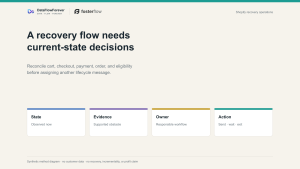
Build a Shopify cart Flow that refreshes contact, cart, delivery, payment, and order evidence before each message, then sends, waits, exits, or hands off.
What Repeat Product Views Can—and Cannot Tell Shopify Merchants Before Checkout
A repeat product view is a useful lifecycle signal, but it does not reveal the shopper’s objection. Learn how to connect consented behavior with verified product evidence before sending a follow-up.