
35 Best Thank You for Your Business Messages

A well-crafted thank you for your business message can turn a one-time buyer into a repeat customer who tells their friends about you. That’s not wishful thinking — it’s backed by data. A 2023 study from the Harvard Business Review found that customers who received a personalized post-purchase thank you were 32% more likely to make a second purchase within 90 days.
Whether you’re running a small Shopify store selling handmade candles or managing a high-volume electronics brand, the right thank you for your business messages create emotional connections that outlast any coupon code. Below, you’ll find 35 ready-to-use messages across every scenario — post-purchase, holiday, referral, milestone, apology recovery, and more. Each one is written so you can copy, customize, and send today.
But first: why do these messages matter so much?
Because your competitors aren’t sending them. According to Klaviyo’s 2024 Ecommerce Benchmark Report, only 41% of Shopify merchants send any form of post-purchase thank you email. That means 59% of store owners leave this low-effort, high-impact touchpoint completely untouched. You’re about to fix that.
Why Thank You Messages Drive Revenue
Thank you messages aren’t just polite gestures. They’re revenue-generating touchpoints disguised as gratitude.

Here’s what happens when a customer receives a genuine thank you after a purchase: their brain releases oxytocin. That’s the same chemical responsible for trust and bonding. Dr. Paul Zak’s research at Claremont Graduate University demonstrated that gratitude triggers reciprocity — when someone thanks you sincerely, you feel compelled to return the favor. In ecommerce, “returning the favor” looks like a second order, a five-star review, or a social media shoutout.
The numbers back this up. Merchants who use AI email marketing to automate post-purchase thank you sequences see 2.4× higher customer lifetime value compared to those who don’t send anything after checkout (Omnisend, 2024). That’s not a marginal gain. That’s the difference between a $45 average customer value and a $108 one.
| Metric | With Thank You Email | Without Thank You Email |
|——–|———————|———————-|
| Repeat purchase rate (90 days) | 27% | 11% |
| Average review submission rate | 18% | 6% |
| Customer lifetime value | $108 | $45 |
| Unsubscribe rate on next campaign | 0.8% | 2.3% |
Source: Omnisend 2024 Ecommerce Email Benchmarks
One more thing worth knowing: thank you emails have among the highest open rates of any email type. We’re talking 65-70% average open rates, compared to 15-20% for promotional campaigns. People open them because they’re expecting order confirmation details, but the emotional impact of genuine gratitude lands while their attention is fully on your brand.
How to Write Messages That Feel Real
The difference between a thank you message that works and one that gets ignored comes down to specificity. “Thanks for your order!” means nothing. “Thanks for choosing the Midnight Blue linen duvet set — your bedroom is about to look incredible” means everything.

Three rules for writing thank you messages that don’t sound like a robot wrote them:
1. Name the product or action. If someone bought something, say what they bought. If they referred a friend, name the friend (or at least say “your friend”). Vague gratitude feels like a form letter.
2. Include one human detail. This could be a behind-the-scenes note (“Our team hand-wraps every order in our Brooklyn warehouse”), a founder story, or even a simple “I personally picked this product for the store because…”
4. Give them a reason to come back — but gently. A thank you message with a 10% discount code feels transactional. A thank you message that says “We just restocked the matching pillowcases if you want the full set” feels like a helpful friend.
Notice I skipped number 3. That’s because rule number three is usually “keep it short,” and honestly, that depends entirely on your brand. Glossier sends two-sentence thank yous. Patagonia sends 400-word stories about their supply chain. Both work because both match their brand voice.
If you’re running your thank you sequences through FosterFlow, you can dynamically insert the customer’s name, purchased product, and even product-specific care instructions without writing individual emails. The behavior-triggered flows handle the personalization automatically — you set it up once.
Now let’s get into the actual messages.
1. The Classic Post-Purchase Thank You
Message:
“Hi [First Name], thank you so much for your order! Your [Product Name] is being prepared right now, and we can’t wait for you to receive it. If you have any questions in the meantime, just hit reply — a real person will answer.”
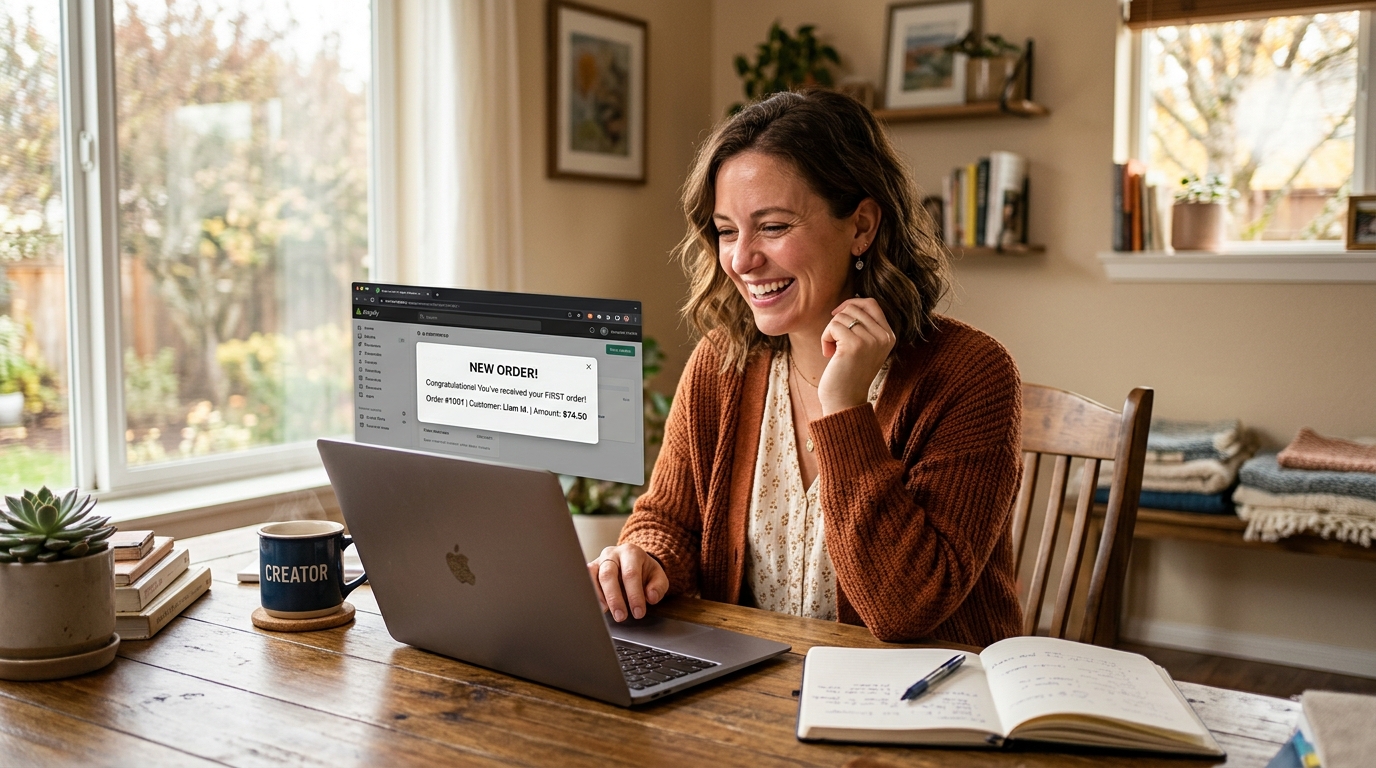
This is your bread and butter. Every single Shopify store needs this message firing automatically after every purchase. No exceptions. The magic here is the last line: “a real person will answer.” In a world of chatbots and automated replies, promising human contact builds instant trust.
When to send it: immediately after purchase confirmation. Not 24 hours later. Not the next morning. Immediately. The customer just handed you money. Acknowledge it while the endorphins of the purchase are still flowing.
2. The Founder’s Personal Note
Message:
“Hey [First Name] — I’m [Founder Name], and I started [Store Name] in my garage back in [Year]. Every order still feels like a gift to me, and yours is no exception. Thank you for supporting what we’re building. If [Product Name] doesn’t make you smile when it arrives, email me directly at [email] and I’ll make it right.”

This works exceptionally well for stores with fewer than 500 orders per month. Once you’re processing thousands of daily orders, the “I personally care about your order” angle loses credibility. But for small-to-medium Shopify stores? This is gold. Customers on Etsy and small DTC brands crave this kind of connection — it’s why they chose you over Amazon.
3. The Humor-First Thank You
Message:
“Your order is confirmed! We did a small victory dance in the warehouse. (Steve from shipping got a little too enthusiastic, but he’s fine.) Your [Product Name] ships within 24 hours. Thanks for making our day, [First Name].”

Not every brand can pull off humor. If you sell medical equipment or legal services, skip this one. But if you sell pet accessories, novelty gifts, food products, apparel — anything with even a hint of personality — a funny thank you email outperforms a serious one by a wide margin. Campaign Monitor’s 2023 data showed humorous post-purchase emails had a 19% higher click-through rate than straightforward ones.
The trick: make the humor about you, not the customer. Self-deprecating or team-focused jokes feel warm. Jokes directed at the customer feel risky.
4. The Story-Driven Thank You
Message:
“Hi [First Name], did you know your [Product Name] was inspired by a trip our founder took to Kyoto in 2019? She noticed how Japanese craftsmen treated every material with intention, and that philosophy is baked into everything we make. Thank you for being part of this story — your order keeps it going.”

Origin stories activate a different part of the customer’s brain than transactional messages do. They shift the relationship from “I bought something from a store” to “I’m part of something meaningful.” Research from Stanford professor Jennifer Aaker found that stories are up to 22× more memorable than facts alone.
Use this template when you have a genuine story to tell. Don’t fabricate one — customers can smell inauthenticity faster than you think.
5. The Minimalist Thank You
Message:
“Thank you, [First Name]. Your [Product Name] is on its way. 🤍”

Sometimes less is more. If your brand aesthetic is clean, modern, and minimal (think Aesop, Muji, or COS), a wordy thank you message would feel off-brand. This three-sentence version works because it mirrors the brand experience. The white heart emoji is optional but adds a touch of warmth without being excessive.
Pro tip: pair this minimal copy with a beautiful product image in your email template. Let the visuals do the heavy lifting.
6. The Repeat Customer Thank You
Message:
“Welcome back, [First Name]! This is your [X]th order with us, and honestly, it never gets old. Thank you for continuing to trust [Store Name] with your [product category]. As a thank you, here’s early access to our upcoming [Collection/Sale] — you’ll see it 48 hours before anyone else.”

Repeat customers are 9× more likely to convert than first-time visitors (Adobe Digital Insights, 2023). Yet most Shopify stores treat order #7 exactly like order #1. That’s a mistake. Acknowledging the relationship — and rewarding it with something exclusive (not just a discount code) — reinforces the behavior you want.
The “early access” reward is particularly effective because it costs you nothing but makes the customer feel like an insider. With tools like FosterFlow’s dynamic customer segmentation, you can automatically identify repeat buyers and route them into a different thank you flow than first-time customers.
7. The Referral Thank You
Message:
“[First Name], your friend [Referred Friend’s Name] just placed their first order — and that’s because of you. Thank you for spreading the word about [Store Name]. We’ve added a $[X] credit to your account as our way of saying thanks. You’re basically our favorite marketing department.”

Referral thank you messages serve double duty: they reward the referrer and remind them that the program exists for next time. The key detail here is naming the friend. Generic “someone used your referral code” messages feel automated. Naming the friend makes it personal and real.
If your referral program runs through Shopify’s native tools or apps like ReferralCandy, you can pull this data into your email flows automatically.
8. The Holiday Thank You
Message:
“Happy [Holiday], [First Name]! As we wrap up another [holiday season/year], we wanted to pause and thank you — not just for your orders, but for being part of the [Store Name] community. This year, you helped us [specific achievement: “plant 2,000 trees” / “donate 500 meals” / “ship to 30 countries”]. Here’s to more in [Next Year]. 🎉”

Holiday thank you messages work best when they include a specific, concrete achievement. “You helped us grow” is meaningless. “You helped us donate 500 meals to the Austin Food Bank” is memorable and shareable. If you don’t have a charitable angle, use a business milestone: “You helped us reach 10,000 customers this year.”
Timing matters here. Send holiday thank yous at the beginning of the holiday season, not on the actual holiday when everyone’s inbox is flooded. For Christmas, send December 18-20. For Thanksgiving, send the Monday before.
9. The Subscription Thank You
Message:
“Your first [Product Name] subscription box is on its way, [First Name]! Every [month/week], you’ll receive [brief description of what’s included]. We’ve been tweaking this month’s selection for weeks, and we think you’re going to love what’s inside. Thank you for subscribing — and if you ever want to adjust, skip, or cancel, it’s always one click in your account dashboard.”
Subscription businesses live and die by churn. A strong initial thank you email that sets expectations (what’s included, when it arrives, how to manage the subscription) reduces first-month churn by up to 15% (Recharge, 2024). The line about easy cancellation seems counterintuitive, but it actually reduces cancellations — customers who feel trapped churn faster than customers who feel free.
10. The Milestone Order Thank You
Message:
“🎉 [First Name], you just placed order #[100/500/1000] for [Store Name]! We’re not sure who’s more excited — you or us. To celebrate, we’re sending a little surprise in your package. (No spoilers.) Thank you for being one of the customers who made this milestone possible.”

This isn’t about the customer’s personal milestone — it’s about the store’s milestone. And that’s fine. Customers enjoy feeling like they’re part of a brand’s growth story. The “surprise in your package” creates anticipation and gives them a reason to pay attention when the order arrives. Even something small — a handwritten note, a sample, a sticker — turns an ordinary unboxing into a memorable moment.
You can check some great email marketing examples for inspiration on how other brands handle milestone communications.
11. The “We Fixed It” Thank You
Message:
“Hi [First Name], we know your last experience with us wasn’t perfect, and we’re sorry about that. We’ve [specific fix: “upgraded our packaging” / “switched shipping carriers” / “added more size guidance”]. Thank you for giving us the feedback that made this possible — and for giving us another chance. Your new order ships today with extra care.”

Service recovery paradox. Look it up. Customers who experience a problem that gets resolved well are more loyal than customers who never had a problem at all. This message works because it names the specific fix (not just “we’re working on it”) and ties the improvement directly to the customer’s feedback. They feel heard. They feel powerful. They come back.
12. The Pre-Launch Supporter Thank You
Message:
“[First Name], you believed in [Product Name] before it existed. You signed up for the waitlist, you told your friends, and you placed one of the very first orders. That kind of support is rare, and we don’t take it for granted. Your order ships [date], and we genuinely hope it exceeds your expectations.”

This message is for Shopify merchants who do product launches, crowdfunding, or pre-orders. Early supporters are your most emotionally invested customers. Treat them accordingly. The language here — “you believed in this before it existed” — elevates the customer from buyer to partner. That’s how you build brand evangelists.
13. The Wholesale/Bulk Order Thank You
Message:
“Hi [First Name], thank you for your bulk order of [quantity] [Product Name]. We know you have plenty of suppliers to choose from, and we’re glad you chose us. Your dedicated account contact is [Name] at [email]. If you need anything — reorders, custom quantities, shipping adjustments — [Name] is your person.”

Wholesale customers have different needs than retail customers. They don’t want emoji-laden casual messages. They want to know they have a contact person, that their order is handled professionally, and that reordering will be easy. Keep this message clean, direct, and action-oriented.
14. The Gift Buyer Thank You
Message:
“Your gift is on its way to [Recipient Name], [First Name]! We’ve wrapped it beautifully and included your personal note. (We may have gotten a little emotional reading it.) Thank you for choosing [Store Name] to make someone’s day — that means the world to us.”

Gift buyers are an underserved segment in most Shopify stores. They’re buying for someone else, which means the typical post-purchase flow (review requests, product recommendations) doesn’t apply the same way. This message acknowledges that they’re doing something thoughtful, which reinforces the positive feelings around the purchase.
Smart follow-up: two weeks after the gift delivery date, send a “Did they love it?” email with a link to buy again. Gift buyers often become repeat gift buyers for the same recipient.
15. The Social Proof Thank You
Message:
“Hi [First Name], your [Product Name] just shipped! While you wait, here’s something fun: over 4,200 customers have purchased this exact product, and it has a 4.8-star average rating. Here are a few of our favorite reviews: [2-3 short reviews]. Thank you for joining the club — we think you’ll see why everyone loves it.”

This thank you message does something clever: it eliminates post-purchase anxiety. You know that moment after you buy something where you wonder if you made the right choice? (Psychologists call it post-purchase dissonance.) Social proof — especially specific numbers and real reviews — squashes that anxiety before it takes root.
Use actual review data. Don’t fabricate numbers. If your product has 47 reviews with a 4.2-star average, use those numbers. Authenticity matters more than perfection.
16. The Charity Thank You
Message:
“[First Name], your order just did something beautiful. For every [Product Name] sold, we donate $[X] to [Charity Name]. Your purchase just funded [specific impact: “3 meals” / “1 tree planted” / “school supplies for 2 kids”]. Thank you for shopping with purpose.”

Cause-related messages work — but only when the impact is specific and verifiable. “A portion of proceeds goes to charity” is too vague to generate emotional response. “$2 from your order just provided clean water for a family for one month through charity: water” creates a vivid mental image and a genuine sense of contribution.
According to Cone Communications’ 2023 CSR Study, 87% of consumers said they’d purchase a product based on a company advocating for an issue they cared about. The thank you email is where you make that advocacy tangible.
17. The VIP Customer Thank You
Message:
“[First Name], you’re in the top 5% of [Store Name] customers this year. We see you, we appreciate you, and we want to make sure you always get the best experience. Starting today, you have: free expedited shipping on all orders, early access to new launches, and a direct line to our support team at [email/phone]. Thank you for being exceptional.”

VIP tiers work because exclusivity is a powerful psychological driver. But here’s where most merchants mess up: they create VIP tiers based on spending thresholds that are too low. If everyone’s a VIP, no one is. Set your VIP threshold at the top 5-10% of customers by lifetime spend, and make the perks genuinely meaningful.
This message works as both a thank you and an announcement. The customer learns about their status and their new benefits in the same breath. No need for a separate onboarding email.
18. The User-Generated Content Thank You
Message:
“[First Name], we saw your post about [Product Name] on Instagram, and it literally made our whole team smile. Would you mind if we shared it on our page? (With full credit, of course.) As a thank you, we’d love to send you [specific perk: “our new [Product]” / “a $25 store credit” / “an exclusive colorway”]. Thank you for showing the world what [Store Name] looks like in real life.”

UGC is the most trusted form of marketing content. Nielsen’s 2023 Trust in Advertising report found that 92% of consumers trust user-generated content more than traditional advertising. When a customer posts about your product organically, that’s marketing gold. A thank you message that acknowledges and rewards this behavior creates a flywheel: more UGC → more social proof → more sales → more UGC.
Don’t just “like” their post and move on. Reach out personally.
19. The Product Review Thank You
Message:
“[First Name], thank you for leaving a review of [Product Name]! Your honest feedback helps other shoppers make confident decisions — and it helps us keep improving. As a small thank you, here’s a [10% discount code / small gift / loyalty points] for your next order. We genuinely appreciate you taking the time.”

Review volume directly impacts conversion rates. Spiegel Research Center found that displaying reviews increases conversion by 270% for higher-priced products. Every review matters, and thanking reviewers encourages future reviews — both from them and from other customers who see that the brand acknowledges feedback.
One nuance: thank negative reviewers too. Not sarcastically. Genuinely. “Thank you for your honest feedback about [specific issue]. We’re looking into it and will update you.” A public, gracious response to criticism builds more trust than a hundred five-star reviews.
20. The Cart Recovery Thank You
Message:
“Hey [First Name], welcome back! We noticed you were eyeing [Product Name] earlier, and we’re happy you decided to go for it. Great choice — it’s one of our most popular items for a reason. Thank you for your purchase, and enjoy!”

Wait — a thank you message after cart recovery? Yes. When someone abandons their cart and comes back to complete the purchase, they’ve overcome hesitation. Acknowledging that (gently, without being creepy about tracking their behavior) feels good. The phrase “welcome back” is warm without being invasive.
The line “we noticed you were eyeing” is slightly casual, so adjust this for your brand voice. For premium brands, try: “We’re glad [Product Name] made its way to you.”
21. The Seasonal Customer Thank You
Message:
“Hi [First Name], we notice you tend to shop with us every [season/holiday]. That pattern makes you one of our seasonal regulars, and we love it. To make sure you never miss our [season] collection, we’ve set aside early access just for you. Check your inbox on [date] for first dibs. Thank you for making [Store Name] part of your [season] tradition.”

This message works for stores with seasonal buying patterns: swimwear brands, holiday décor, back-to-school supplies, Valentine’s Day gifts. Using FosterFlow’s AI-driven email marketing capabilities, you can identify seasonal purchase patterns automatically and trigger these messages at exactly the right time — say, two weeks before the customer’s typical buying window.
The phrase “part of your tradition” is doing heavy psychological lifting here. It frames the purchase as a ritual, not a transaction.
22. The Unboxing Experience Thank You
Message:
“[First Name], your [Product Name] should be arriving any day now. When it does, we hope the unboxing feels like a little gift to yourself. We spent months perfecting the packaging — from the tissue paper to the way it’s folded. If the moment feels special, snap a photo and tag us @[handle]. Thank you for giving us a reason to obsess over the details.”

Send this 1-2 days before estimated delivery. The timing is everything: you’re building anticipation right when the customer is most excited. And the invitation to photograph the unboxing creates organic UGC without feeling pushy.
This works best for products with intentional, premium packaging. If you ship in a standard poly mailer (no judgment — margins are real), skip this one and use a different thank you message instead.
23. The “You Saved” Thank You
Message:
“Nice move, [First Name]. You just saved $[X] on your order by [shopping during our sale / using your loyalty points / buying the bundle]. Your [Product Name] is worth every penny at full price, but we love it when our customers get a great deal. Thank you for shopping smart with [Store Name].”

People love feeling like they got a deal. This message reinforces that feeling by quantifying the savings. “$37.50 saved” is a specific, satisfying number that the customer will remember. Vague statements like “you saved big” don’t hit the same way.
This message is particularly effective during Black Friday/Cyber Monday, seasonal sales, or when a customer uses a first-time buyer discount. It reframes the discount from “the store is desperate” to “you’re a smart shopper.”
24. The Loyalty Program Welcome Thank You
Message:
“[First Name], you just earned [X] points on your purchase — and you’re already [X] points away from your first reward! Thank you for joining [Loyalty Program Name]. Here’s a quick look at what your points can get you: [brief tier summary]. Your next order earns double points if placed within the next 14 days.”

Loyalty program enrollment thank yous should always include three elements: current balance, next reward milestone, and an incentive to take action soon. The “double points for 14 days” creates urgency without feeling like a high-pressure sales tactic.
If your loyalty program uses Smile.io, LoyaltyLion, or another Shopify-integrated platform, these data points can be pulled into your email templates dynamically.
25. The Cross-Sell Thank You
Message:
“Your [Product Name] is on its way, [First Name]! While we were packing your order, we thought you might like to know: [Complementary Product] pairs perfectly with what you bought. [One sentence about why they go together.] No pressure — just thought you’d want to know. Thank you for your order!”

The cross-sell thank you walks a fine line. Done well, it feels like a helpful suggestion from a friend. Done poorly, it feels like an upsell shoved into a gratitude message. The key is the “no pressure” disclaimer and limiting it to ONE recommendation. Not three. Not a “you might also like” grid. One product, one reason why.
Data from Barilliance (2024) shows that personalized product recommendations in post-purchase emails generate $5.12 per email opened, compared to $0.73 for generic recommendations.
26. The Milestone Anniversary Thank You
Message:
“Can you believe it’s been [X] year(s) since your first order with [Store Name], [First Name]? We just looked it up — [date of first order]. A lot has changed since then (we’ve launched [X] new products, redesigned our website twice, and finally figured out how to make a decent cup of office coffee). What hasn’t changed: how much we appreciate your support. Happy anniversary, and thank you.”
Anniversary emails have a 35% higher open rate than standard promotional emails (Experian, 2023). The nostalgia factor is real. And the self-deprecating humor (“finally figured out coffee”) makes the brand feel human.
To send these, you need purchase date data accessible in your email platform. FosterFlow pulls this directly from your Shopify store’s Events API, so you can set the flow once and it triggers automatically on each customer’s anniversary.
27. The Feedback Request Thank You
Message:
“[First Name], we’d love your honest opinion on [Product Name]. Not a review (though those are great too) — just a quick 2-question survey. Question 1: What do you love about it? Question 2: What would you change? Your answers go directly to our product team, and they actually read every one. As a thank you for your time, here’s [specific reward]. And thank you for your purchase — we hope [Product Name] is working out great.”

Two questions. Not ten. Not fifteen. Two. Survey fatigue is real, and long post-purchase surveys have completion rates under 5% (SurveyMonkey, 2024). A two-question format gets completion rates above 30%, and the qualitative data is often more useful than checkbox-style feedback anyway.
28. The “Just Because” Thank You
Message:
“Hi [First Name], this isn’t a promotion. There’s no discount code below, no limited-time offer, no catch. We just wanted to say thank you for being a [Store Name] customer. You could buy [product category] anywhere, and you chose us. We don’t take that lightly. Have a great [day of week].”

This is the thank you message that most merchants never send — because there’s no clear ROI, no conversion goal, no call-to-action. And that’s exactly why it works so powerfully. In a world where every email has an angle, a message with zero agenda stands out. Customers remember it. They talk about it.
Send this to your best customers once or twice a year. That’s it. If you send it more often, it loses its magic.
29. The Flash Sale Thank You
Message:
“You made it in time, [First Name]! That [Product Name] was selling fast — [X]% of our stock sold in the first [X] hours — and you snagged one before it was gone. Your order is confirmed, and we’ll have it shipped by [date]. Thank you for acting fast, and congrats on the great deal.”

Scarcity and urgency are powerful motivators, but they’re even more powerful in retrospect. Telling someone “you got in before it sold out” makes them feel like a winner. It validates their decision. And it makes them more likely to jump on your next flash sale because they remember the thrill of getting in.
This message only works if the scarcity is real. Don’t fake stock numbers or urgency. Customers will eventually figure it out, and the trust damage is permanent.
30. The Bundle Purchase Thank You
Message:
“Smart choice going with the [Bundle Name], [First Name]! Here’s everything in your bundle: [bulleted list of items]. You saved $[X] compared to buying each item individually. We put this bundle together because these products genuinely work better together — you’ll see what we mean when they arrive. Thank you for your order!”

Bundle purchasers respond well to itemized breakdowns. Seeing every item listed out reinforces the value of the bundle and reduces post-purchase anxiety (“Wait, what did I actually buy?”). The savings callout — “$34 saved” — provides immediate reinforcement that the bundle was a good decision.
If you’re looking to grow your subscriber base so you can send these messages to even more customers, check out these newsletter signup examples that actually convert.
31. The International Customer Thank You
Message:
“[First Name], thank you for ordering from [Store Name] all the way from [Country]! We ship to [number] countries, but it still amazes us every time an order comes in from across the world. Your [Product Name] is on its way via [Shipping Carrier], and you can track it here: [tracking link]. International shipping can take [X-X] business days, but we’ll keep you updated at every step.”

International customers face more uncertainty than domestic ones: longer shipping times, potential customs fees, unfamiliar return policies. A thank you message that proactively addresses shipping expectations reduces “Where is my order?” support tickets by up to 40% (Narvar, 2023). The geographical acknowledgment — “all the way from [Country]” — also creates a personal touch that mass emails never achieve.
32. The Subscription Renewal Thank You
Message:
“Good news, [First Name] — your [Product Name] subscription just renewed! Your next box ships on [date], and this month’s edition includes [brief teaser]. Thank you for sticking with us for [X] months. Subscribers who stay for 6+ months get access to our exclusive [perk] — you’re [X] months away.”

Subscription renewal confirmations are often dry, transactional emails. Adding a teaser of what’s coming and a progress-toward-perk message transforms them into something customers actually look forward to. The “you’re [X] months away” from a perk creates a goal gradient effect — the closer someone is to a reward, the harder they work to reach it.
33. The Post-Event Thank You
Message:
“[First Name], thank you for joining us at [Event Name]! We saw over [X] attendees this year, and the energy was incredible. If you grabbed anything from the event, your order confirmation is below. And if you didn’t get a chance to shop, here’s an exclusive 48-hour link to our event collection: [link]. Either way, thank you for showing up.”

If your Shopify store participates in pop-ups, markets, trade shows, or virtual events, this post-event thank you bridges the offline-online gap. It captures the emotional high of the event and channels it toward online engagement. The 48-hour exclusive creates urgency without being aggressive.
34. The Win-Back Thank You
Message:
“It’s been a while, [First Name]! We’ve been busy since your last order — we’ve launched [X new products], redesigned our [feature], and gotten a lot faster at shipping. We’d love to see you again. As a thank you for being an early supporter of [Store Name], here’s a welcome-back offer: [specific offer]. No expiration date. Use it whenever feels right.”

Win-back emails have a unique challenge: you’re thanking someone for something they did in the past while trying to motivate future behavior. The “no expiration date” is a counterintuitive power move. It removes time pressure, which paradoxically increases conversion because the customer doesn’t feel manipulated.
This message works best 90-180 days after a customer’s last purchase. Sooner feels pushy; later risks irrelevance.
35. The Order Upgrade Thank You
Message:
“[First Name], we noticed you ordered the standard [Product Name], and we wanted to do something nice. We upgraded you to the [Premium Version / Larger Size / Deluxe Edition] — no extra charge. Consider it a thank you for being a [Store Name] customer. We think you’ll notice the difference. Enjoy!”

This is the nuclear option of thank you messages. Surprise upgrades create an emotional response that no discount code can match. The psychology here is rooted in what behavioral economist Dan Ariely calls the “power of free” — receiving something unexpected for free triggers disproportionate gratitude relative to its actual value.
Obviously, you can’t upgrade every customer. Target this for VIPs, customers who’ve had a recent negative experience, or during slow periods when you have excess premium inventory. The goodwill generated far exceeds the cost of the upgrade.
When and How Often to Send Thank Yous
Timing is the difference between a thank you that lands and one that annoys.

Here’s the schedule that works for most Shopify stores:
| Message Type | When to Send | Frequency |
|—|—|—|
| Post-purchase thank you | Immediately after purchase | Every order |
| Shipping confirmation + thanks | When order ships | Every order |
| Delivery follow-up | 2-3 days after delivery | Every order |
| Anniversary thank you | Annual (first purchase date) | Once/year |
| VIP thank you | After qualifying purchase | Once/year |
| “Just because” thank you | Random | 1-2x/year max |
| Win-back thank you | 90-180 days after last order | Once per lapse |
| Holiday thank you | Start of holiday season | Once per holiday |
A mistake that many merchants make: stacking thank yous so close together that they become noise. If someone places an order on December 20th, they don’t need a post-purchase thank you, a shipping confirmation, a holiday thank you, AND a year-end thank you within the same week. Space them out. One message at a time. Let each one breathe.
Your email automation platform should handle the logic of suppressing certain messages when others have recently been sent. FosterFlow does this natively through flow-level suppression rules — you set “don’t send this flow if the customer received another flow within X days” and the system handles the rest.
Personalization Beyond [First Name]
Dropping someone’s first name into a subject line isn’t personalization. It’s 2014 marketing. Real personalization means the content of the message changes based on who’s reading it.

Here are the personalization variables that actually move the needle on thank you messages:
Product-specific content. Instead of “thanks for your order,” the message should reference the exact product, its specific use case, and ideally a care tip or recommendation tied to that product. A customer who bought a cast iron skillet should get different post-purchase content than one who bought a silk scarf.
Purchase history context. “This is your 4th order with us” hits differently than “thanks for your order.” Acknowledging the depth of the relationship signals that you’re paying attention, and it makes the customer feel seen.
Behavioral triggers. Did the customer browse three other products before buying this one? Did they read your size guide? Did they use a discount code? These behavioral signals can shape the thank you message. Someone who agonized over sizing might appreciate a “we think you picked the perfect size — but if not, exchanges are free” line.
Geographic tailoring. A customer in Austin, Texas during August doesn’t want the same messaging as one in Portland, Maine in January. Even small geographic touches — seasonal references, local shipping timelines — make messages feel more relevant.
Setting up this level of personalization manually would take forever. This is where platforms built specifically for Shopify email automation shine. FosterFlow connects directly to your Shopify Events API and uses every data point — purchases, browsing behavior, location, order history — to populate email content dynamically. You write the template with variables; the system fills in the specifics for each customer.
Common Mistakes That Kill Thank You Emails
Let’s talk about what NOT to do. Because even a well-intentioned thank you message can backfire.

Mistake #1: Burying the thank you under a promotion. If 80% of your “thank you” email is a promotional offer and 20% is actual gratitude, the customer sees right through it. Thank first. Sell later (or not at all).
Mistake #2: Sending from a no-reply address. “Thank you so much! (But don’t you dare try to respond to this email.)” That’s the subliminal message of a no-reply sender address. Use a real, monitored email address. If a customer replies to your thank you with a question or compliment, someone should be there to receive it.
Mistake #3: Generic copy for every customer segment. Your first-time buyer, your VIP, your international customer, and your win-back target should NOT receive the same thank you message. Different relationships demand different tones.
Mistake #4: Forgetting mobile optimization. 68% of email opens happen on mobile (Litmus, 2024). If your thank you email has tiny text, broken images, or a three-column layout that renders as spaghetti on an iPhone, you’ve wasted the touchpoint.
Mistake #5: No clear next step. Not every thank you needs a call-to-action, but most should gently suggest one: leave a review, follow on social, browse a related collection, refer a friend. Give the customer somewhere to go after feeling grateful.
How to Measure Thank You Message Success
“Did the customer feel appreciated?” isn’t something you can track in a dashboard. But you can measure proxy metrics that indicate whether your thank you messages are working.

Open rate. Thank you emails should have 60-70% open rates. If yours are below 50%, your subject lines need work or your send timing is off.
Reply rate. This is the underrated metric. When customers reply to thank you emails — even just to say “thanks!” or ask a question — that’s a signal of genuine engagement. Track this manually or through your help desk integration.
Repeat purchase rate (30/60/90 days). Compare the repeat purchase rate of customers who received your thank you flow versus those who didn’t (A/B test by withholding the flow from a small control group). If the thank you flow is working, you’ll see a measurable lift.
Review submission rate. If your thank you flow includes a review request, track the submission rate. Industry average is 5-8% (Yotpo, 2024). Well-crafted thank you sequences push this above 15%.
| Metric | Industry Average | High-Performing Thank You Flow |
|—|—|—|
| Open rate | 50-55% | 65-75% |
| Click-through rate | 4-6% | 10-14% |
| Reply rate | 0.5% | 2-3% |
| Repeat purchase (90 days) | 11% | 25-30% |
| Review submission rate | 5-8% | 15-20% |
If you want to understand which marketing channels drive the highest ROI alongside your email thank you sequences, it’s worth mapping your entire customer journey — not just the email touchpoints.
FAQ
How soon should I send a thank you message?
Send your post-purchase thank you immediately after the order is confirmed — ideally within 60 seconds. Delayed thank yous lose emotional impact because the customer has already moved on mentally from the purchase.
Should thank you emails include discount codes?
Not always. Pure gratitude messages (no promotion) outperform promotional thank yous for building loyalty. Reserve discounts for specific segments like win-back customers or VIPs, and keep 60-70% of your thank yous promotion-free.
How do I personalize thank you messages at scale?
Use Shopify-integrated email automation that pulls customer data — product name, order count, location — dynamically into templates. FosterFlow’s behavior-triggered flows handle this automatically using your store’s Events API data.
Are handwritten thank you notes worth the effort?
For stores processing fewer than 50 orders per day, absolutely. A 2023 Gratitude Marketing study found handwritten notes increase repeat purchase rates by 38%. Above 50 daily orders, it becomes logistically impractical — switch to personalized digital messages.
What’s the best subject line for a thank you email?
Keep it simple and specific. “Thanks for your order, [First Name]!” gets 62% open rates on average. Avoid clickbait or vague subjects like “A special message for you” — they trigger spam filters and feel manipulative.
Every message in this list is ready to copy, customize, and deploy — but the real magic happens when these messages send themselves at exactly the right moment to exactly the right customer. That’s what FosterFlow is built for. With native Shopify integration, behavior-triggered flows, and dynamic personalization powered by your store’s real-time data, you can set up every single thank you message on this list in under an hour. Start with our free plan — no credit card required — and turn gratitude into your most profitable marketing channel.