
How to Build a Win-Back Flow That Reactivates 15% of Churned Customers

Every Shopify store has a segment of customers who used to buy regularly — and then disappeared. Not because of a bad experience. Not because of a competitor. Often just because of timing, distraction, or the simple fact that you stopped showing up in their inbox.
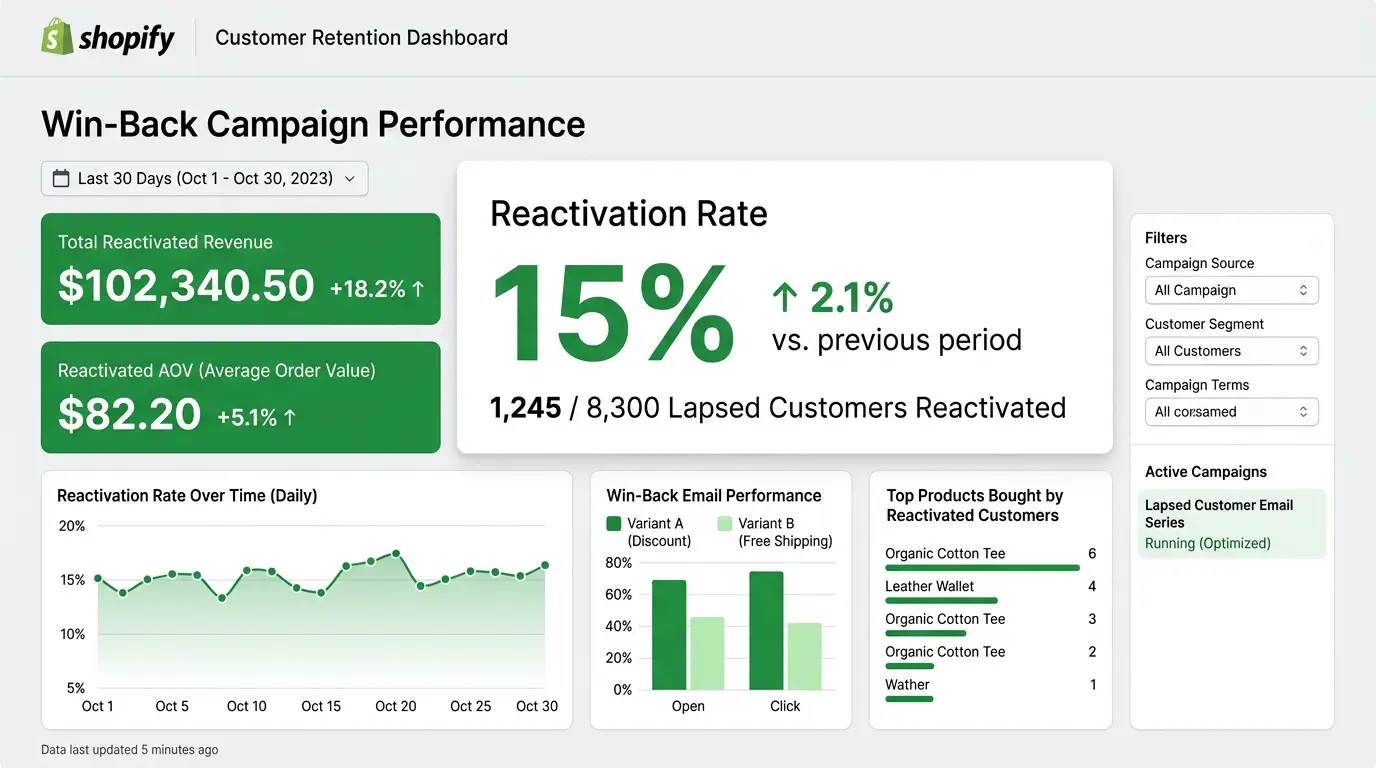
A well-executed win-back email flow can reactivate 10–15% of lapsed customers — and because these are people who have already bought from you, they convert at 2–5x higher rates than cold prospects. You don’t need to convince them your products are worth buying. You just need to remind them you exist and give them a compelling reason to come back.
This post walks through the complete win-back flow strategy: who to target, the exact email sequence, subject line formulas, discount strategy, and how to know when to stop.
What Is a Win-Back Email Flow?
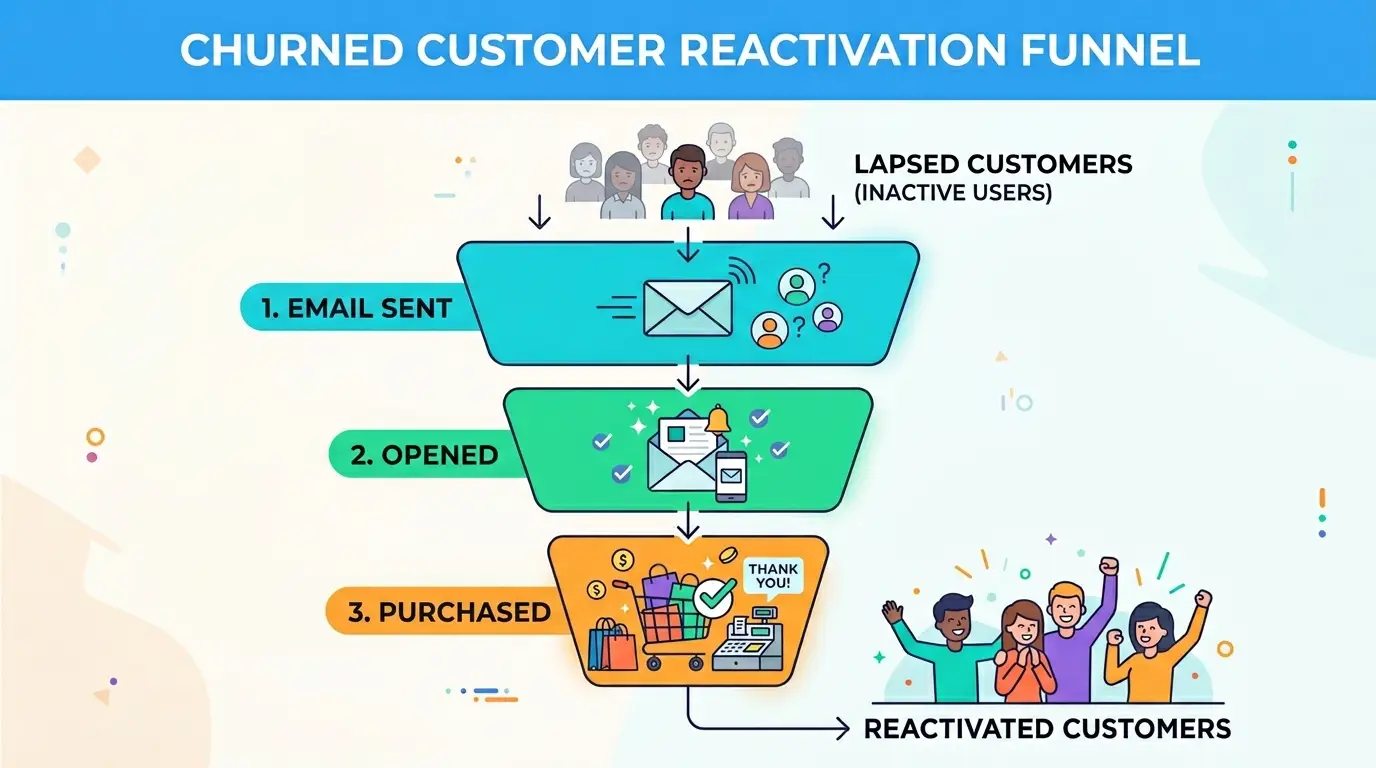
A win-back flow (also called a re-engagement or lapsed customer sequence) is an automated series of emails sent to customers who haven’t purchased in a defined period of time.
The goal is straightforward: re-engage customers before they fully churn and become unresponsive. Unlike standard promotional emails sent to your whole list, win-back flows are triggered by inactivity — making them highly relevant and personalized to the recipient’s current state.
Why win-back flows matter economically:
- Acquiring a new customer costs 5–7x more than retaining an existing one
- Lapsed customers convert at 3–5x the rate of cold traffic when re-engaged properly
- Even a 5% improvement in customer retention can increase profitability by 25–95% (Bain & Company)
A win-back flow is one of the highest-ROI investments you can make in your email program.
Who to Target: Defining “Lapsed”
Before building the flow, you need to define what “lapsed” means for your store. This depends on your average purchase frequency (APF) — how often a typical customer buys.
APF-Based Lapse Thresholds
| Purchase Frequency | Lapse Definition |
|—|—|
| Monthly (supplements, consumables) | 45–60 days since last purchase |
| Quarterly (apparel, beauty) | 90–120 days since last purchase |
| Annual (furniture, large appliances) | 12–18 months since last purchase |
For most Shopify stores selling consumables or repeat-purchase products, the standard starting point is 90 days since last purchase. For fashion or lifestyle brands with 2–4 purchases per year, use 120–180 days.
Prioritizing Within Lapsed Segments
Not all lapsed customers are equal. Prioritize your win-back investment based on customer lifetime value:
- High-value lapsed (3+ orders or $200+ total spend): Deploy your full 3-email sequence with a meaningful offer
- Mid-value lapsed (2 orders or $100–$200 total spend): 2-email sequence with a moderate incentive
- One-time buyers (1 order, <$100 spend): 1–2 emails; if unresponsive, sunset quickly
Use Shopify’s customer data or a tool like FosterFlow’s segmentation builder to create these tiers automatically before the flow fires.
The 3-Email Win-Back Sequence
Email 1: The Soft Re-Engagement (Day 90)
The first email should be warm and low-pressure. Its job is not to sell — it’s to re-open the relationship.
Timing: Trigger on Day 90 (or your defined lapse threshold) since last purchase.
Subject line formulas:
- “We’ve been thinking about you, [First Name]”
- “It’s been a while — here’s what’s new”
- “[First Name], we miss having you around”
- “A lot has changed since your last order”
Body copy approach:
- Open with a personal, genuine acknowledgment that they haven’t been around
- Highlight what’s new: new products, new collections, improvements since they last visited
- Do NOT include a discount in Email 1 — many customers will re-engage without one, and leading with a discount trains your list to expect incentives before buying
- CTA: “See What’s New” or “Come Take a Look” — low commitment, low friction
Key insight: This email often gets the highest open rate in the sequence because the subject line triggers curiosity. Don’t waste it with a hard sell.
Email 2: The Value-Driven Offer (Day 105)
If the customer opened Email 1 but didn’t purchase — or didn’t open at all — Email 2 brings more substance.
Timing: 15 days after Email 1 (Day 105 from last purchase).
Subject line formulas:
- “Your favorites are waiting — plus a little something for you”
- “Because you’ve been with us since [Year]…”
- “We put together something just for you”
- “[First Name], these are perfect for you”
Body copy approach:
- Personalize based on purchase history: surface products in the same category as their last order
- If you have review data, lead with your highest-rated products in their preferred category
- Introduce a modest incentive: free shipping, or 10% off. Frame it as a thank-you, not a desperation discount
- CTA: “Shop Now” with a personalized product grid
Segmentation tip: If a customer previously bought skincare, show skincare recommendations — not your general bestsellers. FosterFlow’s dynamic content blocks let you pull in category-specific product recommendations automatically based on purchase history.
Email 3: The Last Chance (Day 120–130)
The final email in the sequence is your most direct. The customer has been given two opportunities to re-engage. Now it’s time to make a clear offer and establish a deadline.
Timing: 15–25 days after Email 2 (Day 120–130 from last purchase).
Subject line formulas:
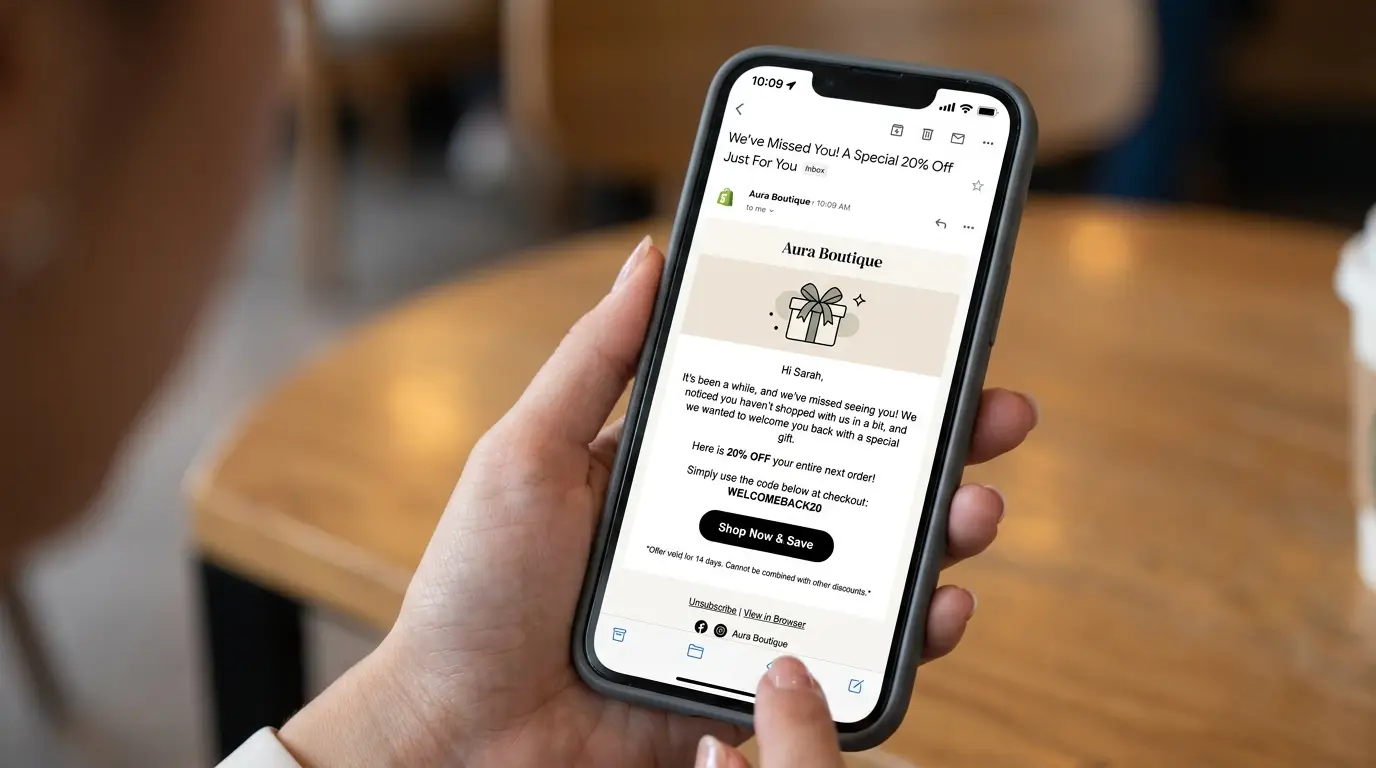
- “Last chance: your 20% off expires soon”
- “We don’t want to say goodbye, [First Name]”
- “This offer is about to disappear”
- “One last thing before we part ways…”
Body copy approach:
- Be direct: “We’d love to have you back. Here’s our best offer.”
- Offer a meaningful incentive: 15–20% off, a gift with purchase, or free express shipping
- Include a countdown or expiry date: “This offer expires in 48 hours”
- Keep the email short — 3–4 sentences, one strong CTA
- Include a gentle close: “If you’d prefer not to hear from us, you can unsubscribe below. No hard feelings.”
Important: If the customer still doesn’t engage after Email 3, do not keep sending them promotional emails. Move them to a sunset segment (see below).
Subject Line Formulas That Work
Subject lines are where most win-back flows get lazy. Here are formulas that perform across store categories:
Curiosity-based:
- “Something we thought you should know…”
- “We made a few changes since you left”
- “A lot happened while you were away”
Personal:
- “Checking in, [First Name]”
- “We haven’t forgotten about you”
- “[First Name] — a message from [Brand]”
Offer-forward (Email 3 only):
- “Your exclusive 20% off is waiting”
- “We saved something for you”
- “Your last chance at this offer, [First Name]”
A/B test one variable at a time: Start with personal vs. curiosity-based in Email 1, then optimize from there.
Discount Strategy for Win-Back Flows
The most common mistake in win-back flows is discounting too early and too aggressively. Here’s the recommended escalation:
| Email | Incentive Level | Rationale |
|—|—|—|
| Email 1 | No discount | Test organic re-engagement first |
| Email 2 | Soft offer (free shipping or 10%) | Reward interest without devaluing brand |
| Email 3 | Strong offer (15–20% or BOGO) | Maximum effort before sunsetting |
Avoid discounting one-time buyers in Email 1. You don’t know yet whether they respond to price signals or to novelty/relationship messaging. Let the sequence tell you.
For high-AOV stores ($150+): A percentage discount is usually more motivating than free shipping. “Save $30 today” beats “Free shipping on your order” for a $150 cart.
For low-AOV stores (<$50): Free shipping can be the deciding factor. Many customers abandon re-purchase consideration specifically because of shipping costs.
When to Sunset Unengaged Customers
Not every lapsed customer is worth pursuing indefinitely. Continuing to send emails to chronically unengaged subscribers hurts your sender reputation and can lead to deliverability issues across your entire list.
The Sunset Protocol
After Email 3, if a customer has not:
- Opened any of the 3 win-back emails
- Clicked any link
- Made a purchase
…send a final sunset email approximately 14 days after Email 3.
Sunset email subject line: “Should we stay in touch, [First Name]?”
Body: A single sentence or two. “We’ve sent a few emails recently and haven’t heard back. We don’t want to fill your inbox if it’s not helpful — so we’re giving you one last chance to stay connected. If we don’t hear from you, we’ll remove you from our active list. No hard feelings.”
Include two CTAs:
- “Yes, keep me on the list” (a click re-adds them to the active segment)
- Unsubscribe link
This email accomplishes two things: it gives genuinely interested customers one final chance to signal engagement, and it cleanly removes uninterested contacts — protecting your list health.
Expected Results
For a Shopify store with 2,000 lapsed customers in the 90–180 day window:
| Metric | Estimate |
|—|—|
| Email 1 open rate | 35–45% |
| Email 2 open rate | 25–35% |
| Email 3 open rate | 20–30% |
| Overall reactivation rate | 10–15% |
| Reactivated customers | 200–300 |
| Avg. order value | $75 |
| Recovered revenue | $15,000–$22,500 |
These numbers improve significantly when flows are segmented by customer value tier and personalized with purchase-history-based product recommendations.
Building This Flow in FosterFlow
A win-back flow with the structure above — 3 emails, delay-based triggers, lapse segmentation, and sunset logic — can be complex to configure manually. Done right, it requires:
- Automatic detection of purchase lapse dates
- Suppression of customers who purchase mid-sequence
- Segmentation by customer value tier
- Dynamic product recommendations based on purchase history
- Sunset branching logic
FosterFlow handles all of this within its visual flow builder. You can set up the full 3-email win-back sequence with proper segmentation, delays, and suppression logic in a single session — no developer needed, no duct-taped app integrations.
The best time to launch a win-back flow was six months ago. The second best time is today.
Start your FosterFlow free trial and get your win-back sequence live before another month of lapsed customers goes uncontacted.